Post Cycle Therapy (PCT)
Post Cycle Therapy (PCT) refers to the medication-assisted recovery period following an androgen cycle, during which the suppressed hypothalamic-pituitary-gonadal axis (HPTA) is reactivated and the estrogen-driven negative feedback loop is normalized.
Mechanism of Action of PCT Compounds
Exogenous androgens suppress GnRH release from the hypothalamus via negative feedback, and subsequently suppress LH and FSH from the pituitary — bringing endogenous testosterone production to a halt. PCT intervenes at three points: SERMs (Tamoxifen, Clomiphene) block estrogen receptors at the hypothalamus and pituitary, thereby lifting the negative feedback and reactivating LH/FSH secretion. Aromatase inhibitors (Anastrozole, Letrozole, Exemestane) reduce estradiol production by inhibiting CYP19A1 aromatase. HCG acts as an LH analogue, directly stimulating the Leydig cells in the testes — independently of the axis status. Additionally, Cabergoline as a dopamine agonist lowers elevated prolactin levels, and Mesterolone binds SHBG, increasing the free androgen fraction.
Product Range by Compound Class
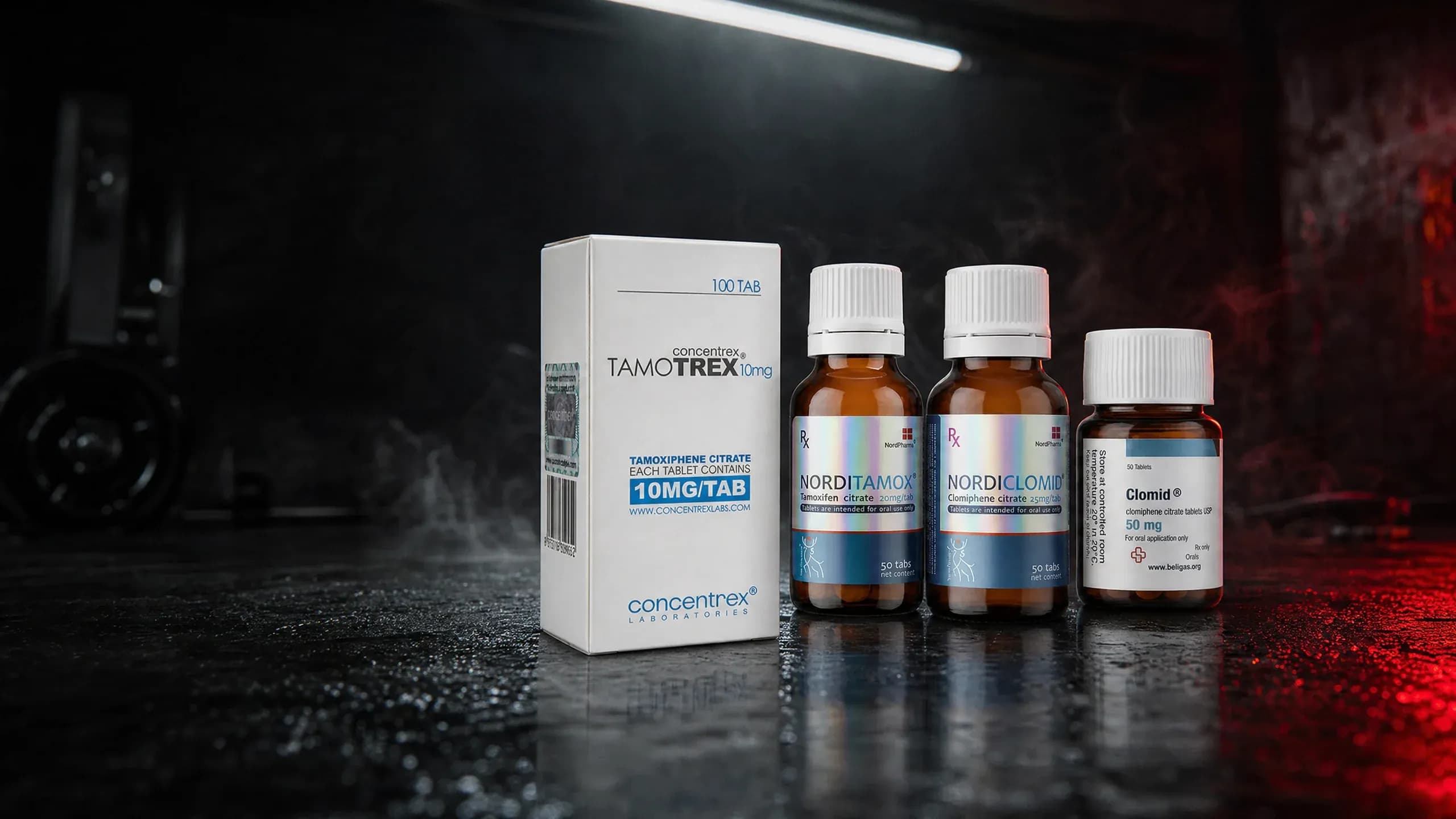
The range comprises 61 preparations across 8 active ingredient groups: Tamoxifen Citrate (12 products) and Anastrozole (12) as the most widely used SERM and AI options respectively, Clomiphene Citrate (11), Mesterolone (11), Letrozole (5), Exemestane (5), HCG (3 preparations at 5000 IU each), and Cabergoline (2). Represented manufacturers range from originator products (Pregnyl/MSD, AstraZeneca) to established specialist manufacturers such as Knoll Pharmaceuticals and Sterling Knight.
Protocol Classification
The start of PCT is determined by the half-life of the last ester used: 3–5 days after short esters (Propionate), and 14–21 days after the last injection for long esters (Enanthate, Decanoate). Standard protocols combine 4–6 weeks of SERM administration with an optional HCG phase beforehand; aromatase inhibitor dosing is guided by estradiol blood values rather than blanket fixed schedules.
Frequently Asked Questions
When should PCT begin after a cycle?
The starting point depends on the half-life of the last ester used: 3–5 days after Propionate, 10–14 days after Enanthate/Cypionate, and 18–21 days after Decanoate or Undecylenate. Starting too early blocks active receptors while exogenous androgen levels are still high; starting too late prolongs the phase of low hormone levels.
What is the difference between a SERM and an aromatase inhibitor in PCT?
SERMs such as Tamoxifen selectively block the estrogen receptor at the hypothalamus and pituitary, thereby reactivating LH/FSH secretion — they form the backbone of PCT. Aromatase inhibitors reduce estrogen production itself, but are used only as a supplement guided by blood values due to the risk of excessive estradiol suppression.
Is HCG part of PCT or part of the cycle?
HCG acts directly on the testes and cannot reactivate the HPTA axis — in fact, it suppresses it. For this reason, HCG is classically used during the final weeks of a cycle or in the transition phase before the SERM start, not concurrently with the SERM phase. It prepares the Leydig cells for endogenous LH stimulation.

 Lab Tested