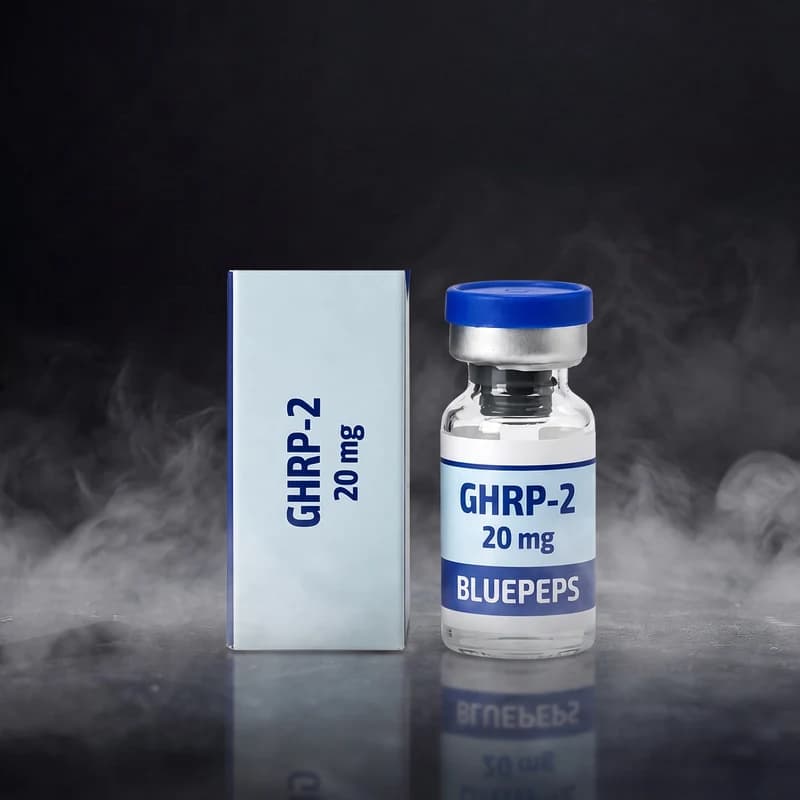
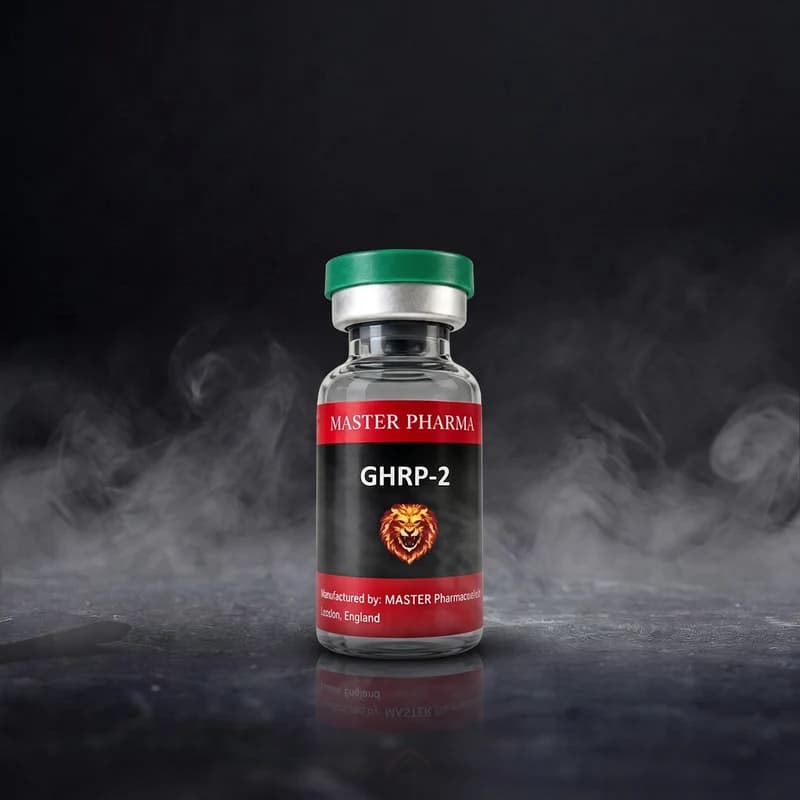
GHRP-2: Mechanism and Pharmacological Profile
GHRP-2 (Growth Hormone Releasing Peptide-2) is a synthetic hexapeptide secretagogue that stimulates endogenous growth hormone release by acting on the ghrelin receptor (GHSR-1a) in the pituitary gland and hypothalamus. Structurally, GHRP-2 belongs to the Met-enkephalin family of peptides and carries the amino acid sequence D-Ala-D-βNal-Ala-Trp-D-Phe-Lys-NH₂, conferring high receptor selectivity and resistance to enzymatic degradation compared with earlier first-generation analogues.
GHRP-2 binds the growth hormone secretagogue receptor type 1a (GHSR-1a) with nanomolar affinity, triggering a Gq/11 protein-coupled intracellular cascade that elevates intracellular calcium and stimulates somatotroph cells to release stored GH in a pulsatile fashion. This mechanism operates independently of — yet synergistically with — Growth Hormone Releasing Hormone (GHRH), meaning the two agents used in combination produce a supra-additive GH pulse that neither achieves alone. Concurrently, GHRP-2 mildly suppresses somatostatin tone, the principal inhibitory brake on GH secretion, which further amplifies net release.
Key pharmacokinetic data position GHRP-2 as a short-acting compound: plasma half-life is approximately 15–30 minutes following subcutaneous administration, with peak GH elevation observable within 15–30 minutes of injection and returning to baseline within 90–120 minutes. Bioavailability via the subcutaneous and intravenous routes is markedly superior to oral dosing, which renders injectable lyophilised vials the standard delivery format. Among the GHRP family, GHRP-2 demonstrates the strongest intrinsic GH-releasing potency, outperforming GHRP-6 on a molar basis in several comparative in vivo studies, whilst producing a smaller increase in appetite — a physiological effect linked to ghrelin receptor activation in the hypothalamic arcuate nucleus.
An important secondary effect: GHRP-2 stimulates prolactin and cortisol secretion at higher doses, a characteristic that distinguishes it from GHRH analogues and informs dosing strategy for users seeking to minimise hypothalamic-pituitary-adrenal axis perturbation. A dose range of 100–300 mcg per injection is commonly referenced in research settings, with frequency adjusted to align with the body's natural GH pulsatile rhythm.
Application Context and User Groups
Within the research and performance-enhancement community, GHRP-2 occupies a specific functional niche: it is used to elevate endogenous GH levels without directly introducing exogenous human growth hormone, making it attractive to individuals seeking a more physiological secretion pattern and a lower detection-risk profile in tested sporting environments.
Bodybuilders and physique athletes incorporate GHRP-2 primarily during phases focused on lean tissue accretion, recovery acceleration, and body-composition remodelling. Elevated GH pulses increase circulating IGF-1 produced hepatically, and IGF-1 promotes skeletal muscle protein synthesis via the PI3K-Akt-mTOR signalling pathway — a well-characterised anabolic cascade. Unlike direct anabolic-androgenic steroids, GHRP-2 does not bind the androgen receptor and therefore does not contribute to androgenic side effects; rather, its actions are mediated entirely through the GH/IGF-1 axis.
Strength athletes and masters competitors (typically 35+) show heightened interest in GHRP-2 because endogenous GH secretion declines progressively with age — by approximately 14% per decade from the third decade of life onwards. Augmenting pulsatile GH release through GHSR-1a activation is therefore a strategy to partially offset age-related somatopause without exogenous hormone replacement.
Additionally, GHRP-2 is frequently co-administered with a GHRH analogue such as CJC-1295 or Mod GRF 1-29. This combination leverages two complementary mechanisms — increased GHRH signal amplitude and reduced somatostatin suppression — to produce GH pulses significantly larger than either peptide generates independently. Research protocols examining tissue repair, tendon healing, and sleep-quality improvements have also explored GHRP-2, reflecting the broad downstream effects of GH across connective tissue, central nervous system function, and metabolic regulation.
Users pursuing fat-loss goals value GHRP-2 for GH's lipolytic action, whereby elevated GH levels activate hormone-sensitive lipase in adipocytes, promoting free fatty acid mobilisation. This effect is dose-dependent and most pronounced in visceral and subcutaneous abdominal depots, consistent with the well-documented regional sensitivity of these tissues to GH stimulation.
As a lyophilised peptide, GHRP-2 requires reconstitution with bacteriostatic or sterile water and appropriate cold-chain storage to preserve structural integrity — standard handling knowledge for any serious researcher or experienced user.
Range & Selection by Concentration and Pack Size
Our GHRP-2 category currently offers two concentration tiers across single-vial packs, covering introductory and advanced research requirements with pharmaceutical-grade lyophilised peptide from established manufacturers.
5mg/vial — Entry and Mid-Dosing Tier
The GHRP-2 5mg/vial 1 Vial by Knoll Pharmaceuticals is well-suited to researchers and users new to GHRP-2 protocols, or those running shorter research cycles where precise low-volume dosing is paramount. A 5mg vial reconstituted to a standard 2ml volume yields 250 mcg per 0.1ml — a practical concentration aligned with the 100–300 mcg per injection research range, providing between 17 and 50 injections depending on dose selection. This tier is also appropriate for users co-administering multiple peptides simultaneously who wish to keep individual peptide concentrations manageable. Knoll Pharmaceuticals brings a longstanding reputation in pharmaceutical manufacturing, adding confidence in product consistency.
10mg/vial — Advanced and Extended Research Tier
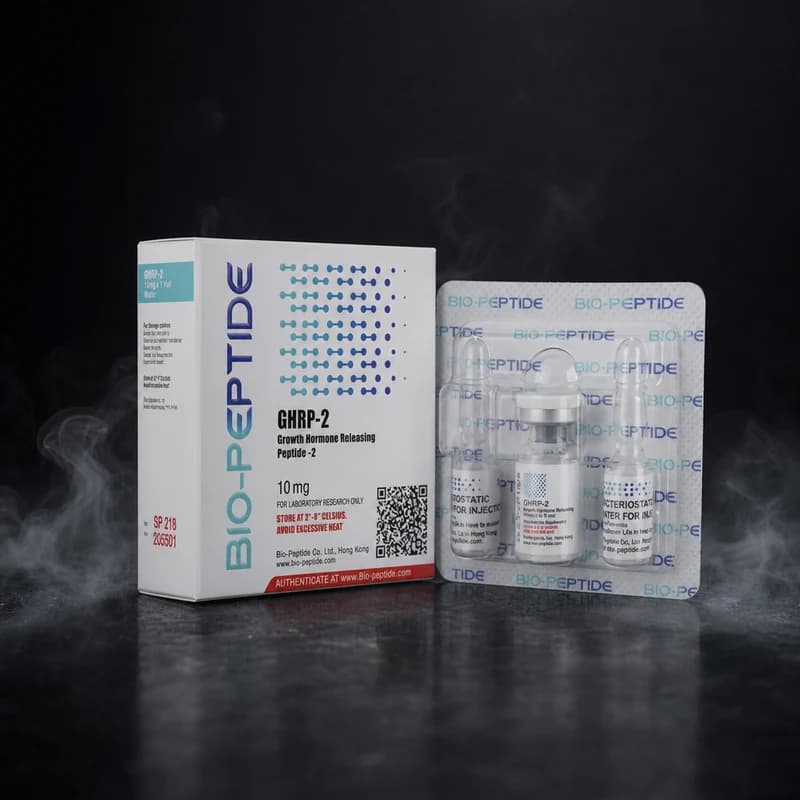
The GHRP-2 10mg/vial 1 Vial by Bio-Peptide targets experienced researchers and advanced users running longer protocols or multiple daily injections, where a higher-mass vial reduces preparation frequency without compromising peptide integrity within the single-use window. A 10mg vial offers greater flexibility in reconstitution concentration, allowing users to dial in volume-per-dose with precision across a wider dosing range. Bio-Peptide is a recognised European peptide manufacturer whose lyophilised products are produced under stringent quality controls, making this vial a reliable choice for structured, longer-duration research programmes.
Selecting Between Tiers
Users beginning with GHRP-2 or running a short exploratory protocol will find the 5mg vial from Knoll Pharmaceuticals the more economical and manageable starting point. Those with established protocols, higher injection frequencies, or the intention to combine GHRP-2 with GHRH analogues in multi-peptide stacks will benefit from the extended supply the 10mg Bio-Peptide vial provides. Both formats are supplied as lyophilised powder and require reconstitution prior to use; neither should be confused with pre-mixed or aqueous solutions.
Frequently Asked Questions
What is the difference between GHRP-2 and GHRP-6 in terms of potency and side effects?
GHRP-2 is generally considered more potent on a molar basis for GH release compared with GHRP-6. However, GHRP-6 produces a more pronounced increase in appetite due to stronger ghrelin-mimetic activity in the hypothalamus. GHRP-2 offers a cleaner GH-release profile with less appetite stimulation, making it preferable for users prioritising lean physique goals over caloric surplus phases.
How should GHRP-2 vials be stored after reconstitution?
Lyophilised GHRP-2 powder should be stored at 2–8°C and kept away from light and moisture prior to reconstitution. Once reconstituted with bacteriostatic water, the solution should be refrigerated and used within 28–30 days. Freeze-thaw cycles after reconstitution degrade peptide integrity and should be avoided entirely to maintain research-grade accuracy.
Can GHRP-2 be used alone or does it require a GHRH analogue?
GHRP-2 is active as a standalone compound and will stimulate measurable GH pulses independently by binding GHSR-1a. However, combining it with a GHRH analogue such as CJC-1295 or Mod GRF 1-29 produces a substantially amplified GH response through complementary mechanisms. Solo use is valid for introductory protocols or where simplicity is preferred; combination use is typical in more structured advanced research settings.


 Lab Tested