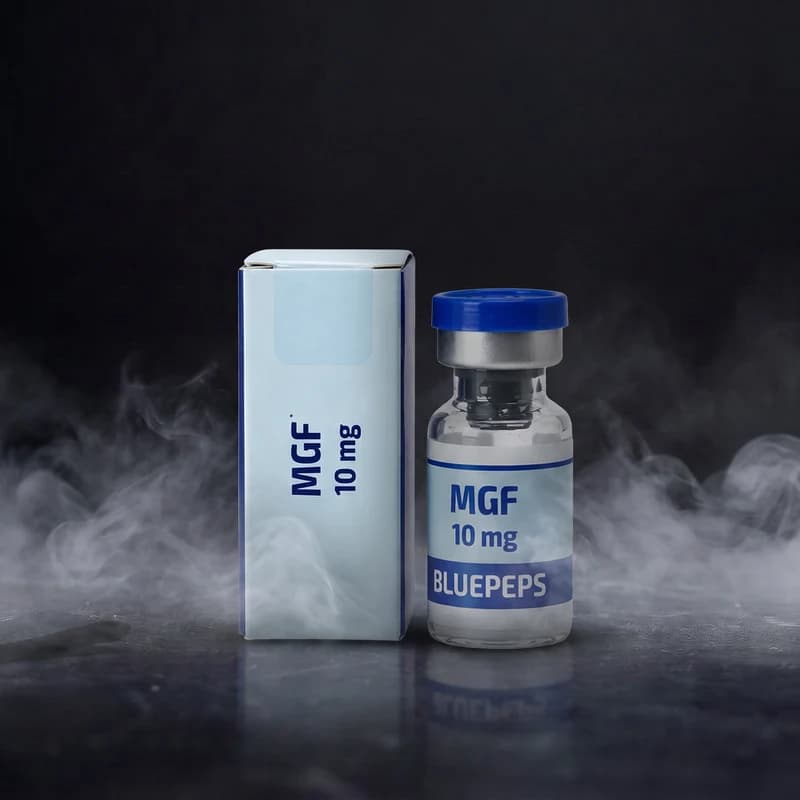
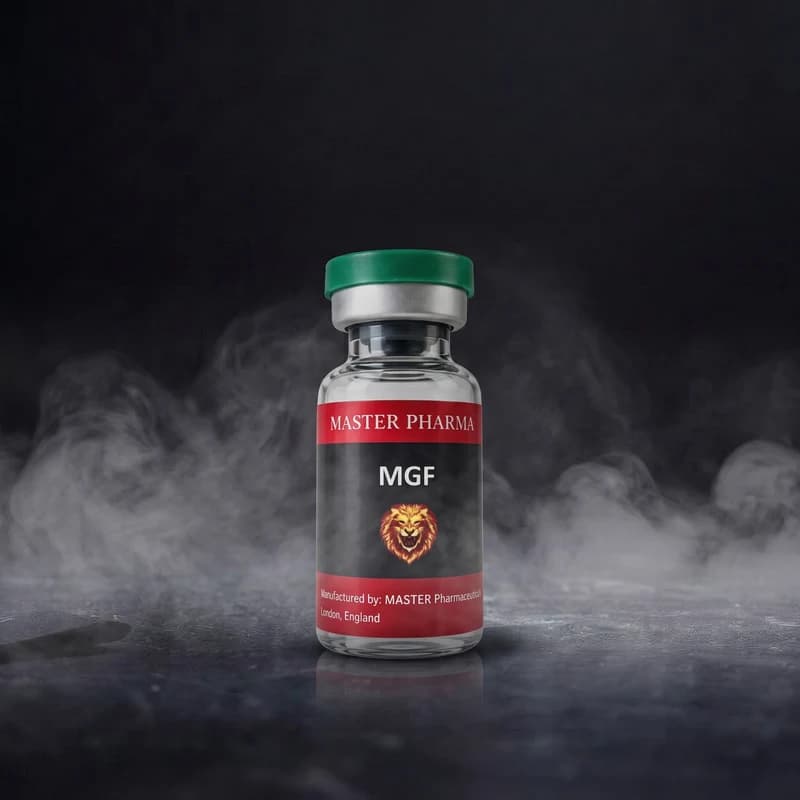
MGF Mechanism and Pharmacology: How Mechano Growth Factor Works at the Molecular Level
MGF (Mechano Growth Factor) is a splice variant of insulin-like growth factor-1 (IGF-1), produced endogenously in skeletal muscle tissue in direct response to mechanical load, microtrauma, or hypoxia. Unlike systemic IGF-1, which circulates broadly and acts on the liver-derived Eb isoform, MGF arises from the Ec exon splice of the IGF-1 gene in humans and exerts highly localised, autocrine–paracrine signalling within the damaged or mechanically stressed muscle environment. This localised specificity is central to its functional identity and is what distinguishes it from other growth factor peptides in the research and performance context.
At the receptor level, MGF binds a distinct binding site that is separate from the canonical IGF-1 receptor (IGF-1R), although it can also engage IGF-1R with lower affinity. The unique C-terminal E-domain peptide of MGF activates quiescent muscle satellite cells — the adult stem cells responsible for muscle fibre regeneration — by triggering cell proliferation cascades before those satellite cells differentiate into mature myofibres. MGF initiates downstream signalling through the PI3K/Akt/mTOR pathway, which promotes protein synthesis and inhibits apoptosis, as well as through MAPK/ERK signalling associated with cell proliferation. The result is a two-phase anabolic response: an early proliferative phase driven by MGF, followed by a differentiation phase driven by systemic IGF-1 Ea.
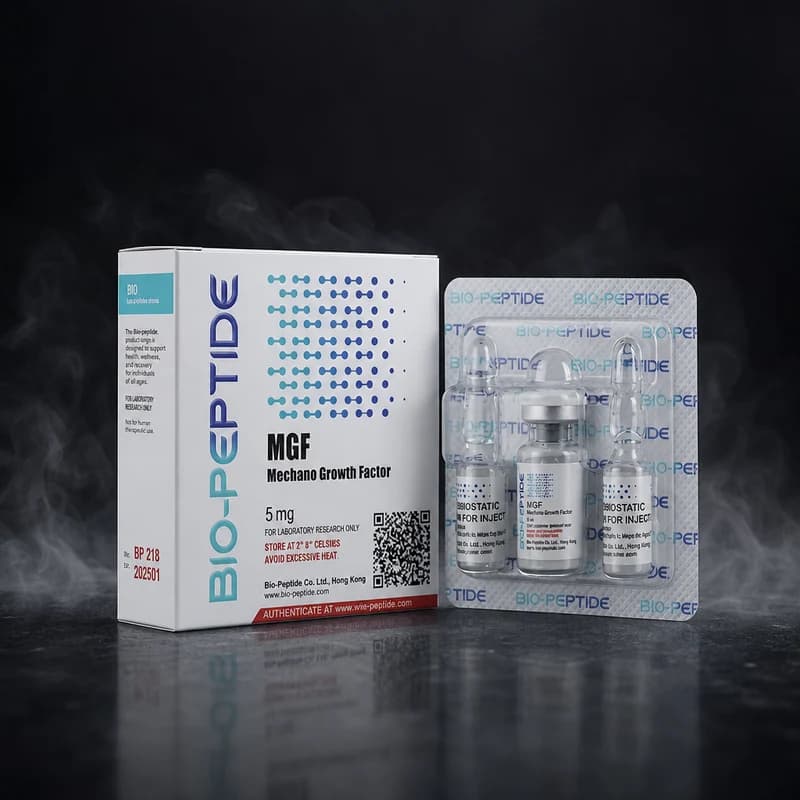
Pharmacokinetically, native MGF presents a significant challenge: its half-life in serum is extremely short, estimated at under five minutes, due to rapid enzymatic degradation. To address this, researchers often work with a pegylated form (PEG-MGF), where polyethylene glycol conjugation extends the half-life to approximately several days, allowing systemic distribution and sustained receptor engagement. The non-pegylated MGF used in peptide research — such as the Bio-Peptide formulation available in this category — acts more analogously to the endogenous splice variant, making immediate post-administration localisation critical to experimental protocols. Molecular weight of the C-terminal MGF peptide fragment is approximately 2,867 Da, and it is typically presented as a lyophilised powder requiring reconstitution with bacteriostatic water prior to use.
Application Context and User Groups: Who Researches MGF and Why
MGF occupies a specific and well-defined niche in the peptide research landscape. Its primary application context relates to the study of skeletal muscle hypertrophy, satellite cell biology, and post-injury tissue regeneration. Because MGF satellite cells activate in a temporally distinct window following mechanical damage, research into its use is closely tied to understanding the repair cycle at a cellular level — a subject of sustained scientific interest since Goldspink and colleagues first characterised the Ec isoform in the late 1990s and early 2000s.
In the context of preclinical and advanced research, MGF is of interest to scientists studying age-related sarcopenia, as the mechano-responsiveness of satellite cells declines significantly with age. Studies have shown that elderly muscle tissue produces substantially less MGF in response to exercise-induced damage than younger tissue, which correlates with impaired muscle mass maintenance in older populations. This makes MGF a compelling subject in regenerative biology and translational gerontology research.
Within the bodybuilding and performance research community, MGF has attracted attention as a localised hypertrophy agent — distinct from systemic growth hormone or IGF-1 use. Researchers and advanced users are drawn to its proposed capacity for site-specific satellite cell recruitment. The understanding is that administration at or near a target muscle group, in close temporal proximity to mechanical load, may better recapitulate the endogenous response than systemic peptides. This has shaped a distinct user profile: intermediate to advanced practitioners who have already explored foundational peptide categories (GHRP, GHRH, IGF-1 LR3) and are investigating more tissue-specific modalities.
It is worth noting that regulatory frameworks vary internationally, and MGF — like all peptides in this category — is supplied strictly for research purposes. The scientific literature supporting MGF is growing but remains predominantly preclinical; human trial data is limited, and users should contextualise findings accordingly. This is not medical advice, and individual decisions regarding use should be made in consultation with a qualified professional.
Range and Selection by Concentration and Pack Size
The MGF category currently features a single concentration tier at 5mg per vial, reflecting the standard dosing reference point established in most published peptide research protocols involving this splice variant. This concentration level is well-aligned with typical investigational use, where precise, milligram-accurate dosing is required to maintain consistency across experimental cycles.
The sole representative product in this category is MGF 5mg/vial 1 Vial by Bio-Peptide, a lyophilised peptide formulation supplied as a single vial per unit. Bio-Peptide is a recognised manufacturer within the research peptide space, known for producing high-purity lyophilised formulations with documented quality processes. Their MGF offering at 5mg delivers a practical single-experiment quantity, making it suitable for researchers initiating protocol design or working in low-volume, high-precision laboratory settings.
For users comparing MGF to PEG-MGF: the 5mg non-pegylated formulation offered here represents the native-analogue approach, suited to research where rapid onset and localised activity are the variables under investigation. Those seeking extended systemic half-life for broader distribution studies would typically look toward pegylated variants, which fall outside this category. The 5mg per vial quantity is a rational entry point for establishing dosing baselines, and single-vial packs offer flexibility for researchers who require fresh reconstituted peptide for each experimental session, minimising degradation concerns associated with repeated freeze-thaw cycles.
Guidance by tier: at the 5mg concentration, this is an appropriate product for experienced researchers who have operational familiarity with peptide reconstitution, aseptic handling, and IGF-family peptide pharmacology. Given the narrow therapeutic window and the sensitivity of satellite cell biology research, precise volumetric preparation using a validated diluent (bacteriostatic or sterile water) is strongly advised. Storage of the lyophilised product at −20°C prior to reconstitution is standard practice.
Frequently Asked Questions
What is MGF peptide and how does it differ from IGF-1?
MGF (Mechano Growth Factor) is a splice variant of IGF-1, generated locally in skeletal muscle following mechanical stress or damage. Unlike systemic IGF-1, MGF acts in an autocrine–paracrine manner, specifically activating satellite cells at the site of microtrauma. Its C-terminal E-domain peptide is structurally and functionally distinct from IGF-1's receptor-binding domain, giving it a unique biological profile in muscle regeneration research.
Why does MGF have such a short half-life, and does it matter for research protocols?
Native MGF is rapidly degraded by serum proteases, with a half-life estimated at under five minutes in blood. This is highly relevant to research design, as it means the peptide acts primarily at the administration site and within a brief temporal window. Pegylated MGF (PEG-MGF) addresses this limitation by extending half-life considerably, but non-pegylated MGF remains valuable for studying localised, endogenous-analogue signalling dynamics.
What concentration of MGF is available, and is 5mg per vial standard?
The current selection features MGF at 5mg per vial, supplied by Bio-Peptide. This concentration is consistent with the dosing references used in most preclinical literature and is considered a practical quantity for structured research use. It allows for multiple sub-milligram administrations per vial when accurately reconstituted, and the single-vial pack format supports freshness and minimises peptide degradation between sessions.


 Lab Tested