MOD GRF 1-29: Mechanism and Pharmacological Profile
MOD GRF 1-29 is a synthetic, stabilised analogue of growth hormone–releasing hormone (GHRH), engineered from the biologically active 1–29 amino acid fragment of native GHRH and further modified at four key residue positions to resist enzymatic cleavage by dipeptidyl peptidase IV (DPP-IV). Also marketed under the alias CJC-1295 without DAC, the compound retains the same 29-amino-acid core sequence responsible for receptor engagement but presents significantly improved pharmacokinetic behaviour compared with unmodified GHRH(1-29), commonly known as Sermorelin.
MOD GRF 1-29 binds the growth hormone–releasing hormone receptor (GHRHR), a Gs protein–coupled receptor expressed predominantly on somatotroph cells of the anterior pituitary. Receptor activation triggers adenylyl cyclase, elevates intracellular cyclic AMP, and stimulates both the synthesis and secreted release of endogenous growth hormone in discrete, pulsatile bursts. This pulsatility is a defining pharmacodynamic feature: unlike secretagogues that flood the pituitary with a sustained signal, MOD GRF 1-29 amplifies natural GH pulses rather than overriding them, helping to preserve the physiological rhythm that governs downstream IGF-1 production, lipolysis, and protein synthesis.
The plasma half-life of unmodified GHRH(1-29) is approximately two minutes, rendering it essentially impractical for subcutaneous administration. The four amino acid substitutions in MOD GRF 1-29 — at positions 2, 8, 15, and 27 — dramatically extend this to a half-life of roughly 30 minutes, which is sufficient to engage the pituitary during the brief window of a subcutaneous injection and produce a measurable GH pulse without persisting long enough to cause tachyphylaxis or sustained receptor downregulation. Bioavailability via subcutaneous delivery is generally cited in the range of 70–80% in peptide research literature, and onset of GH elevation typically occurs within 15–30 minutes of administration, peaking at approximately 30–60 minutes post-injection.
An important pharmacodynamic distinction separates MOD GRF 1-29 from the DAC-conjugated variant, CJC-1295 with DAC. The Drug Affinity Complex (DAC) covalently binds the peptide to circulating albumin, extending half-life to seven to ten days and converting the compound's action profile from pulsatile to continuous. MOD GRF 1-29, without DAC, preserves pulse architecture — a quality that many researchers and advanced users consider physiologically superior for purposes that depend on intact GH feedback axes.
Application Context and User Groups
MOD GRF 1-29 occupies a precise niche within the broader GH secretagogue landscape. Its primary utility lies in synergistic administration alongside a growth hormone–releasing peptide (GHRP), most commonly GHRP-2, GHRP-6, Hexarelin, or Ipamorelin. The rationale is well-supported by receptor-level biology: MOD GRF 1-29 acts on the GHRHR pathway, while GHRPs act on the ghrelin receptor (GHSR-1a). Combining both classes produces a synergistic GH response that can exceed the sum of each compound administered alone by a factor of two to three in experimental models, because the two receptor systems converge downstream at the level of somatotroph activation.
For physique athletes and bodybuilders, this synergistic effect translates into practical benefits across multiple training phases. During caloric surplus phases aimed at hypertrophy, elevated GH promotes nitrogen retention, accelerates protein synthesis at the myofibrillar level, and supports satellite cell proliferation. During caloric restriction phases — contest preparation, recomposition, or extended cuts — the lipolytic activity of GH, mediated partly through antagonism of insulin signalling in adipocytes and upregulation of hormone-sensitive lipase, helps attenuate lean mass catabolism while mobilising stored triglycerides.
Older users and those recovering from connective tissue injuries represent another significant user group. GH plays an established role in collagen synthesis, tendon and ligament remodelling, and bone mineral density maintenance. MOD GRF 1-29 provides a means of stimulating endogenous GH without introducing exogenous recombinant human GH (rhGH), which carries different risk profiles and regulatory considerations.
Timing of administration is typically aligned with the body's natural GH release patterns. Many experienced users dose MOD GRF 1-29 pre-sleep, capitalising on the large nocturnal GH pulse that occurs approximately 60 to 90 minutes after sleep onset, or immediately post-training, when the pituitary is primed for GH release following exercise-induced GHRH upregulation. Standard research dosing protocols range from 100 mcg to 200 mcg per injection, with injection frequency varying from once to three times daily depending on the protocol's aims.
The compound is not classified as an anabolic androgenic steroid and does not directly engage the androgen receptor. This makes it an option sometimes considered by athletes in sports with steroid detection concerns, though detection windows in anti-doping testing continue to expand and should not be assumed to be absent.
Range & Selection by Concentration and Pack Size
The current MOD GRF 1-29 range within this category comprises two products from two manufacturers, available in single-vial format at two distinct concentration tiers.
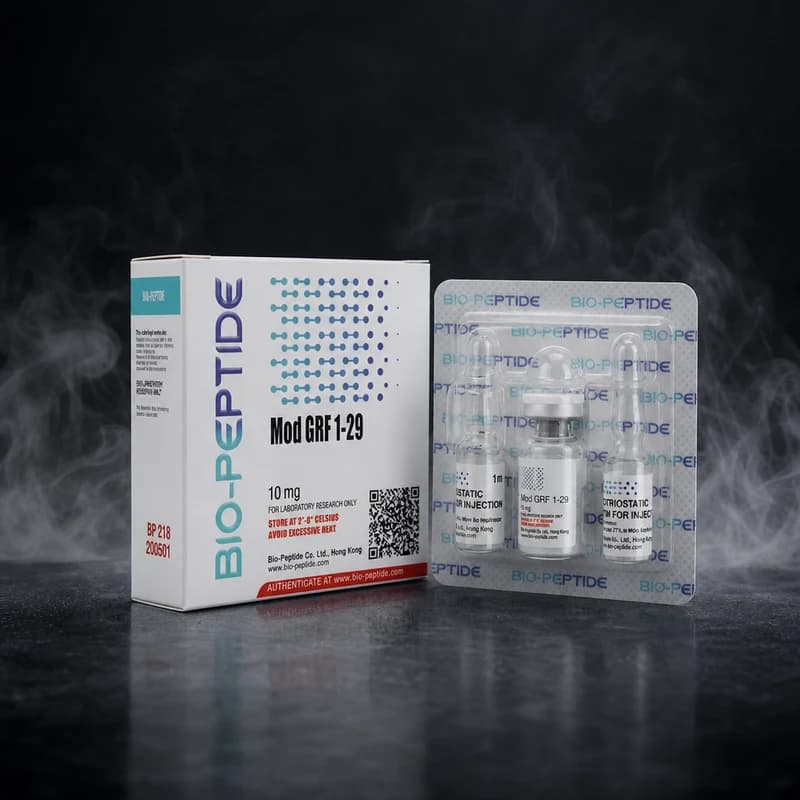
MOD GRF 1-29 10 mg/vial by Bio-Peptide represents the higher-concentration option in this range. At 10 mg per vial, this presentation is suited to researchers and experienced users running longer-duration protocols or higher-frequency dosing schedules. A 10 mg vial, when reconstituted and dosed at the common 100–200 mcg per injection range, yields approximately 50 to 100 individual doses, making it cost-efficient on a per-dose basis and minimising the frequency of vial changes. Bio-Peptide is a recognised European peptide manufacturer with a reputation for consistent lyophilisation quality, relevant here because MOD GRF 1-29's structural integrity is sensitive to improper freeze-drying or reconstitution practices.
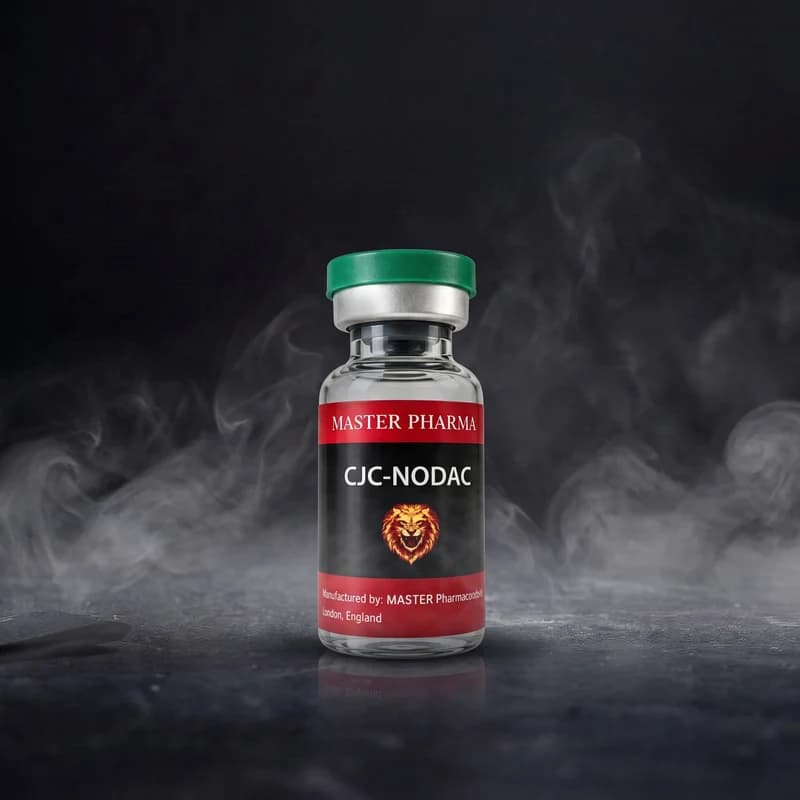
CJC-1295 no DAC 5 mg/vial by Knoll Pharmaceuticals is the 5 mg presentation and carries the alternative nomenclature CJC-1295 without DAC — an accurate and widely used synonym for MOD GRF 1-29. This tier is better suited to users who are either newer to GHRH analogues or who prefer lower commitment per vial, for example when running a short test phase alongside a new GHRP to assess individual response before committing to larger quantities. Knoll Pharmaceuticals brings pharmaceutical-grade manufacturing standards to this presentation, and the 5 mg format remains sufficient for protocols running two to four weeks at standard dosing frequencies.
Both vials are supplied in lyophilised (freeze-dried) powder form and require reconstitution with bacteriostatic water prior to use. Storage of unreconstituted vials should be at 2–8 °C, and once reconstituted, the peptide solution should be refrigerated and used within a timeframe consistent with standard bacteriostatic water stability guidelines. Users selecting between tiers should base their choice primarily on intended protocol length and dosing frequency rather than assuming any pharmacological difference between the two products — the active compound is identical.
Frequently Asked Questions
What is the difference between MOD GRF 1-29 and CJC-1295 without DAC?
They are the same compound. CJC-1295 without DAC is a widely used alternative name for MOD GRF 1-29. Both refer to the four-amino-acid-substituted GHRH(1-29) fragment that resists DPP-IV cleavage and produces pulsatile GH release. The confusion arises because CJC-1295 also exists in a DAC-conjugated form, which has a fundamentally different half-life and GH release profile.
Why is MOD GRF 1-29 typically used alongside a GHRP rather than alone?
MOD GRF 1-29 activates the GHRHR pathway, while GHRPs activate the ghrelin receptor (GHSR-1a). These two receptor systems converge on the same somatotroph cells, producing a synergistic GH pulse significantly greater than either compound generates independently. Using MOD GRF 1-29 alone produces a meaningful GH response, but co-administration with a GHRP is considered the more effective research protocol.
How should MOD GRF 1-29 vials be stored after reconstitution?
Lyophilised vials should be kept refrigerated at 2–8 °C and protected from light until reconstitution. Once reconstituted with bacteriostatic water, the solution should remain refrigerated and is generally considered stable for 28–30 days. Avoid freezing the reconstituted solution, as this can cause peptide aggregation and degrade biological activity.


 Lab Tested