What Is CJC-NODAC and How Does It Work?
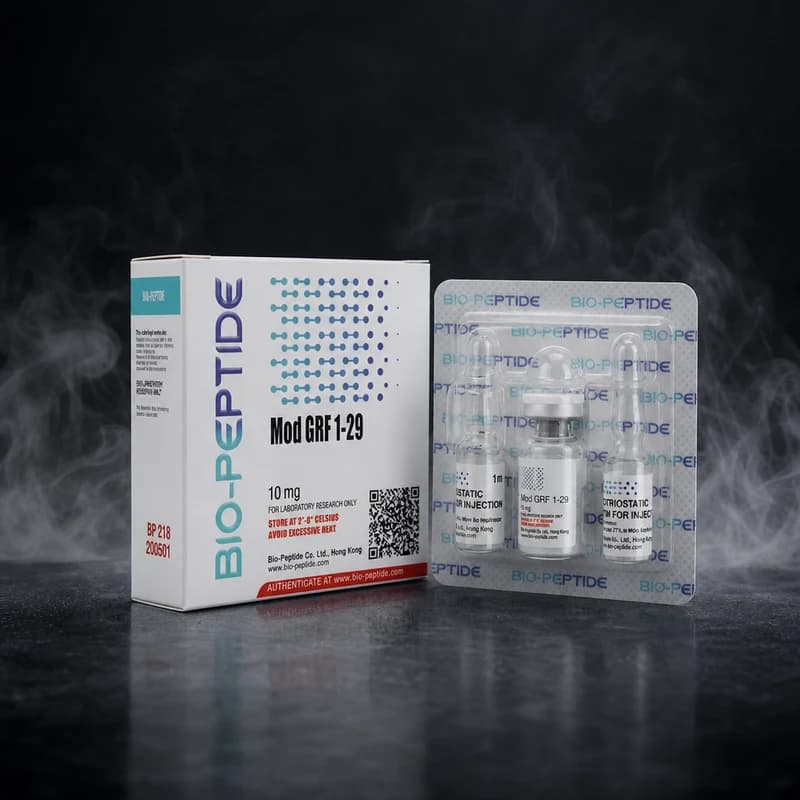
CJC-NODAC (Mod GRF 1-29) is a synthetic 29-amino-acid fragment of growth hormone-releasing hormone that amplifies the pituitary's natural GH pulses by occupying GHRH receptors on somatotroph cells. Unlike modified analogues carrying a Drug Affinity Complex, this no-DAC formulation retains a plasma half-life of approximately 30 minutes (confirmed in pharmacokinetic studies measuring GH peak response), making it well-suited to timed, pulsatile dosing protocols. Master Pharma supplies this ingredient as a lyophilised powder; it must be reconstituted before use, which is precisely the practical focus of this guide.
Reconstituting CJC-NODAC: Step-by-Step
Bacteriostatic water is the standard reconstitution solvent for lyophilised peptides — it contains 0.9 % benzyl alcohol, which inhibits microbial growth and extends in-solution stability to approximately 28 days under refrigeration (2–8 °C), compared to sterile water's 24-hour window. To reconstitute the Master Pharma 5 mg vial, inject 1–2 ml of bacteriostatic water slowly down the side of the vial using a clean insulin syringe; swirl gently rather than shaking to avoid denaturing the peptide chain. At 1 ml total volume, each 100 µl drawn into an insulin syringe delivers 500 µg — a common single-dose reference point used in published GHRH analogue research.
Storing Reconstituted Peptides Correctly
Reconstituted CJC-NODAC requires continuous refrigeration at 2–8 °C and must be kept away from light; a standard laboratory refrigerator satisfies both conditions. The lyophilised powder, by contrast, tolerates short-term ambient storage (below 25 °C, dark) before reconstitution, though long-term stability data supports freezer storage at −20 °C for unopened vials. Never freeze a reconstituted solution — ice crystal formation disrupts peptide structure and reduces active-content yield measurably.
Subcutaneous Injection Technique
Subcutaneous administration targets the hypodermis directly beneath the skin, typically at the abdomen or outer thigh, using a 27–31 gauge insulin syringe. The needle is inserted at a 45° angle (or 90° on pinched tissue), the plunger depressed slowly, and the site rotated with each injection to minimise local irritation. Compared to intramuscular injection, the subcutaneous route produces a slightly slower absorption curve that aligns well with the peptide's 30-minute active window, smoothing the GH pulse profile without sacrificing peak magnitude.

 Lab Tested