Mechanism & Pharmacology of Sermorelin
Sermorelin is a synthetic analogue of endogenous growth hormone-releasing hormone (GHRH), comprising the first 29 amino acids of the native 44-amino-acid peptide and retaining full biological activity at the pituitary receptor. Unlike exogenous recombinant human growth hormone (rhGH), sermorelin acts upstream in the hypothalamic–pituitary axis: sermorelin binds the growth hormone-releasing hormone receptor (GHRHR), a G-protein-coupled receptor expressed on somatotroph cells of the anterior pituitary, triggering a cyclic-AMP-mediated signalling cascade that stimulates the synthesis and pulsatile release of endogenous growth hormone (GH). This preserves the physiological feedback regulation that keeps GH and IGF-1 within natural ranges, a distinction that sets GHRH analogues apart from direct GH administration.
The peptide has a short plasma half-life of approximately 10–12 minutes following subcutaneous injection, attributable to rapid cleavage by serum proteases. Peak GH secretion is typically observed within 20–30 minutes post-administration, mirroring the endogenous GHRH pulse pattern. Subcutaneous bioavailability is generally cited in the range of 15–20 % in clinical pharmacokinetic studies, which is why dosing timing — particularly late evening, to coincide with the natural nocturnal GH surge — is a key variable in research protocols. The downstream effector, insulin-like growth factor 1 (IGF-1), produced primarily in the liver in response to GH stimulation, serves as the principal anabolic mediator and is routinely used as a biomarker to assess sermorelin activity in research subjects.
At the molecular level, sermorelin activates adenylyl cyclase through Gs coupling, elevates intracellular cAMP, and potentiates IP3/DAG pathways, resulting in calcium influx and exocytosis of pre-formed GH granules. The pituitary retains full gatekeeper function throughout this process: elevated somatostatin tone, feedback from circulating IGF-1, or high endogenous GH will blunt the somatotroph response. This autoregulatory ceiling is one reason sermorelin carries a different pharmacodynamic profile from supraphysiological GH administration.
Application Context & User Groups
Within the research and sports-science community, sermorelin occupies a distinct niche among GH-axis peptides. It is frequently investigated in the context of age-related somatotropic decline — the well-documented fall in mean GH pulse amplitude and IGF-1 levels that begins in the third decade and accelerates after 40. Clinical data from studies published in peer-reviewed endocrinology literature indicate that GHRH-based secretagogues can partially restore GH pulsatility in older subjects without the desensitisation risk associated with continuous GH receptor stimulation.
For bodybuilding research applications, three user profiles are commonly considered. First, experienced users looking to support recovery and lean-tissue remodelling during calorically controlled phases show interest in sermorelin for its ability to sustain IGF-1 levels without direct GH introduction. Second, researchers studying the synergy between GHRH analogues and GHRP class peptides — such as GHRP-2 or ipamorelin — explore sermorelin as the GHRH component in combination protocols; the mechanistic rationale is that GHRH primes somatotrophs while GHRPs suppress somatostatin, producing an amplified and more physiologically authentic GH pulse. Third, those evaluating peptide-based approaches to sleep quality and body-composition maintenance use sermorelin for its action on nocturnal GH secretion, which plays a documented role in protein synthesis, lipolysis, and tissue repair during slow-wave sleep.
A key point for any user or researcher to appreciate is that sermorelin's efficacy is conditional on an intact pituitary reserve. In cases of primary pituitary insufficiency, little or no GH release will result regardless of dose, a fact that underscores the importance of baseline assessment in rigorous research contexts. Sermorelin is not a substitute for medical treatment of confirmed GH deficiency and is supplied strictly for research purposes.
Range & Selection by Concentration and Pack Size
The current sermorelin range available in this category features a single, well-specified configuration — 5 mg per vial — which represents the standard research-grade unit for peptide protocols in this class.
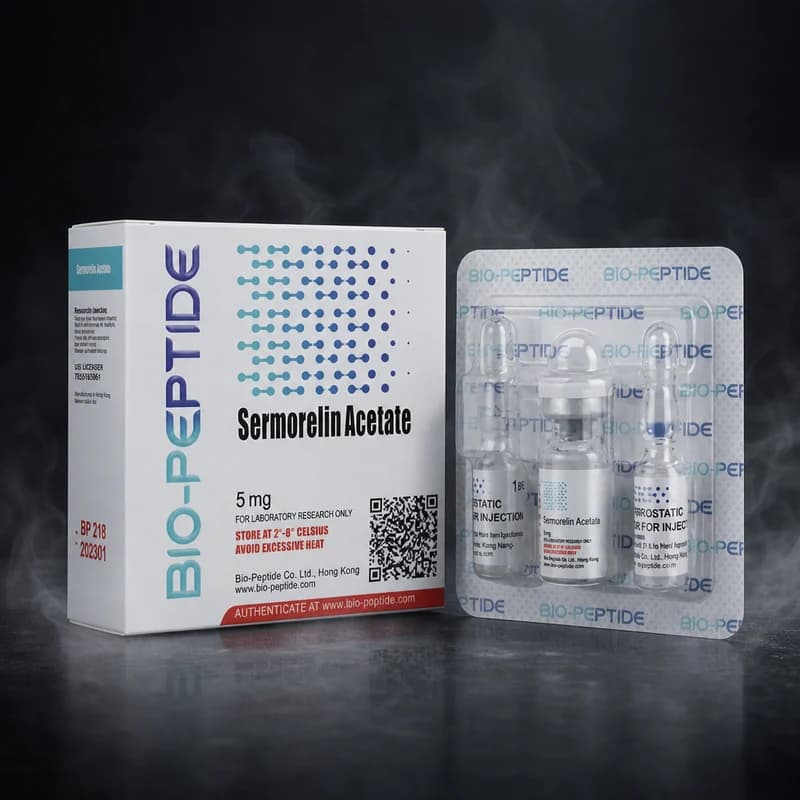
Sermorelin Acetate 5mg/vial 1 Vial by Bio-Peptide is the representative product in this group. Bio-Peptide is a manufacturer with an established track record in research-grade peptide production, and the 5 mg vial format is widely used as the baseline research quantity for short-term investigative protocols. A 5 mg load allows researchers to administer multiple doses at typical experimental quantities (commonly 100–300 mcg per administration in research literature) before resupply is required, providing a practical window for observing GH pulse response and IGF-1 trajectory over several weeks.
For researchers comparing tier options: a single 5 mg vial represents an entry-level or single-cycle research unit, suitable for establishing individual response, baseline IGF-1 changes, and tolerability assessment. Those pursuing longer-duration studies or combination protocols alongside GHRP peptides would typically plan resupply cycles from the outset, as sermorelin's mechanism of building pituitary priming is considered cumulative over weeks rather than acutely dramatic.
When selecting between suppliers, researchers should prioritise documented purity specifications (HPLC), lyophilisation quality, and cold-chain compliance — all factors that directly affect peptide stability and experimental reproducibility. The Bio-Peptide 5 mg format is lyophilised and should be stored at 2–8 °C prior to reconstitution, with bacteriostatic water being the standard reconstitution solvent.
Frequently Asked Questions
How does sermorelin differ from synthetic growth hormone (HGH)?
Sermorelin stimulates the pituitary to release the body's own growth hormone rather than introducing exogenous GH directly. This preserves natural feedback loops, meaning somatostatin and circulating IGF-1 can still moderate output. The result is a more physiologically regulated GH pulse, whereas exogenous HGH bypasses these controls entirely and acts directly on GH receptors in peripheral tissues.
What is the recommended reconstitution volume for a 5mg sermorelin vial?
Most research protocols reconstitute a 5 mg vial with 1–2 mL of bacteriostatic water, yielding a concentration of 2.5–5 mg/mL (2500–5000 mcg/mL). Individual dose volumes are then drawn accordingly. Gentle swirling — not shaking — is advised to avoid peptide degradation. Reconstituted solution should be refrigerated and used within 28 days for best stability.
Can sermorelin be stacked with GHRP peptides in research protocols?
Yes, GHRH analogues such as sermorelin are frequently studied alongside GHRP-class peptides (e.g., GHRP-2, ipamorelin). The mechanistic rationale is complementary: sermorelin activates the GHRHR and primes somatotroph cells, while GHRPs suppress somatostatin tone, together producing a synergistic GH pulse that research suggests is larger than either peptide achieves independently.


 Lab Tested