Hexarelin: Mechanism and Pharmacological Profile
Hexarelin is a synthetic hexapeptide growth hormone secretagogue belonging to the growth hormone-releasing peptide (GHRP) family, structurally derived from GHRP-6 with modifications that confer heightened receptor affinity and GH-releasing potency. Its primary mechanism centres on agonism at the ghrelin receptor — formally designated the growth hormone secretagogue receptor type 1a (GHSR-1a) — a G-protein-coupled receptor expressed densely in the pituitary gland and hypothalamus. When hexarelin binds GHSR-1a, it triggers a signalling cascade involving phospholipase C and inositol triphosphate, culminating in the exocytotic release of stored growth hormone from somatotroph cells.
What separates hexarelin from earlier GHRPs is its dual-pathway activity. Beyond GHSR-1a engagement, hexarelin also demonstrates measurable affinity for the CD36 scavenger receptor, a pathway implicated in cardioprotective and myocardial effects that researchers continue to investigate. This secondary receptor interaction is not shared by compounds such as GHRP-2 or ipamorelin, giving hexarelin a distinctive pharmacodynamic fingerprint worth noting in comparative research contexts.
Pharmacokinetically, hexarelin is administered via subcutaneous or intravenous injection, as peptide bonds render it susceptible to proteolytic degradation in the gastrointestinal tract, making oral bioavailability essentially negligible. After subcutaneous injection, plasma GH concentrations typically peak within 15 to 30 minutes. The half-life of hexarelin in circulation is short — estimated at approximately 30 to 70 minutes depending on the research model — meaning GH pulses are transient but pronounced. Crucially, hexarelin produces GH secretion in a physiologically pulsatile pattern, which tends to preserve the regulatory feedback mechanisms of the hypothalamic-pituitary axis better than continuous exogenous GH infusion.
One pharmacological caveat that distinguishes hexarelin from milder GHRPs is its tendency toward desensitisation with repeated high-frequency dosing. Hexarelin desensitises GHSR-1a more rapidly than ipamorelin, a phenomenon attributed to receptor internalisation and downstream signal attenuation. Research protocols frequently account for this by incorporating cycling strategies or combining hexarelin with a growth hormone-releasing hormone analogue (such as CJC-1295) to amplify the GH pulse while managing receptor downregulation over time. Hexarelin does not appear to significantly suppress endogenous somatostatin in a sustained manner, which allows natural GH release patterns to recover between dosing windows.
Application Context and User Groups
Hexarelin occupies a specific niche within the peptide research and bodybuilding communities, valued primarily for the intensity and reproducibility of the GH pulses it generates. Its utility spans several overlapping areas of interest, each with a distinct evidence and user base.
In the bodybuilding and physique-sport community, hexarelin is sought for its role in promoting anabolic recovery conditions: elevated GH supports lipolysis (the mobilisation of stored fatty acids for energy), enhances collagen synthesis in connective tissue, and contributes to nitrogen retention conducive to lean mass maintenance. Competitive athletes and advanced recreational bodybuilders often place hexarelin within broader peptide stacking protocols, pairing it with IGF-1 analogues or GHRH peptides to create synergistic GH release during defined phases — typically cutting or body recomposition periods where preserving muscle while reducing adipose tissue is the priority.
From an anti-ageing and longevity research perspective, hexarelin is studied for its potential to restore age-related decline in GH secretion. Human GH output decreases by roughly 14–15% per decade after early adulthood, and secretagogues like hexarelin represent a pharmacological tool for exploring whether stimulating endogenous GH pathways — rather than administering exogenous GH directly — can recapitulate some of the tissue-maintenance benefits with a more favourable safety and regulatory profile.
The CD36 receptor affinity opens a separate research avenue in cardiovascular science. Animal model studies have indicated that hexarelin attenuates myocardial damage following ischaemic events, and the peptide has been investigated as a cardioprotective agent independent of its GH-releasing actions. While this research remains largely preclinical, it positions hexarelin as a compound of broader pharmacological interest beyond purely anabolic applications.
A practical consideration for user groups: hexarelin is not regarded as a beginner peptide. Its pronounced GH pulse can accentuate cortisol and prolactin secretion — a common feature of the GHRP class — which experienced researchers factor into protocol design. Ipamorelin is typically recommended as an introductory GHRP precisely because it lacks this cortisol/prolactin blunting effect. Hexarelin is more appropriate for research subjects or athletes with prior experience of GHRP compounds, informed by a thorough understanding of the endocrine context.
Range and Selection by Concentration and Pack Size
The hexarelin category currently features two concentration tiers — 5mg per vial and 10mg per vial — each supplied as a single-vial unit, allowing researchers to select precisely the quantity appropriate to their protocol length and dosing frequency without committing to bulk supply.
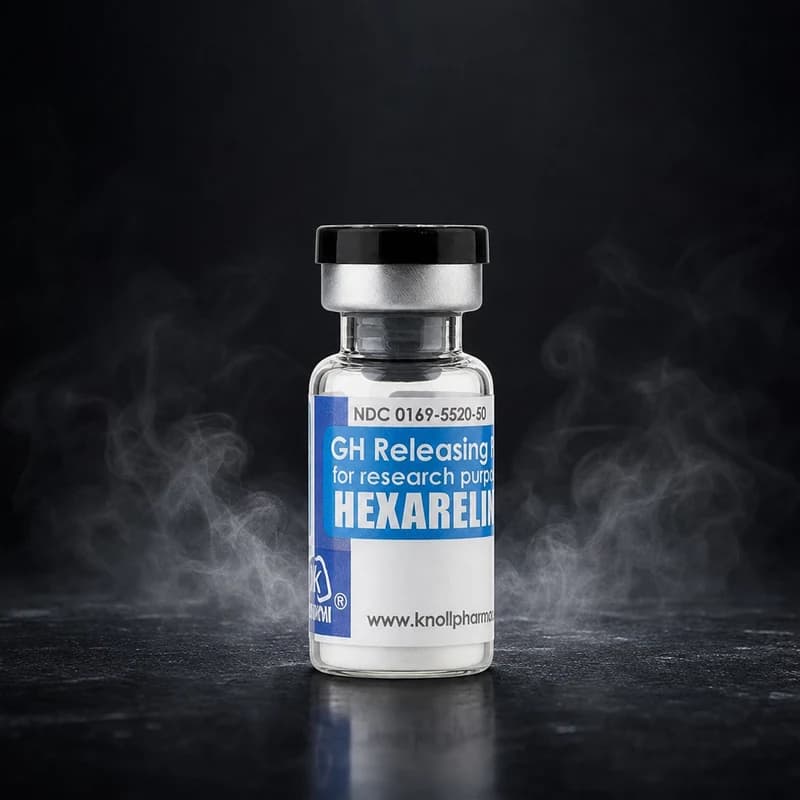
Hexarelin 5mg/vial 1 Vial by Knoll Pharmaceuticals represents the lower-concentration entry point. A 5mg vial is well suited to short-duration research protocols or to investigators who are assessing dose-response thresholds before scaling. It is a practical option for those running hexarelin as a secondary compound within a stack — where another peptide such as a GHRH analogue carries the primary GH-stimulating burden and hexarelin serves as the amplifying pulse agent. The 5mg format minimises waste when precise, modest dosing is required and reduces the risk of over-reconstitution error.
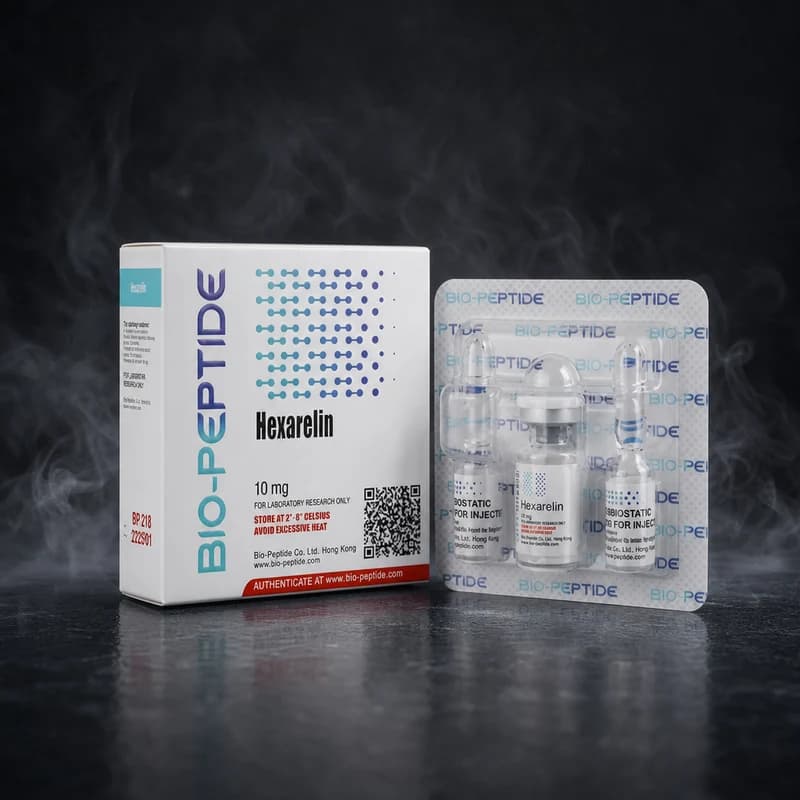
Hexarelin 10mg/vial 1 Vial by Bio-Peptide is the higher-concentration tier and the choice for sustained research runs or protocols in which hexarelin is the principal GH secretagogue. At 10mg per vial, a greater number of administrations can be prepared from a single reconstituted unit, which supports the multi-week cycling approaches documented in research literature. Bio-Peptide's manufacturing credentials are well regarded within the peptide research supply community, making this option particularly suitable for investigators who prioritise consistency across repeated research runs.
Selecting between the two tiers should be guided by protocol duration, dosing frequency, and whether hexarelin is the primary or adjunct compound. For a research window of two to four weeks at moderate injection frequency, the 5mg Knoll Pharmaceuticals vial offers controlled expenditure and precision. For protocols extending four to eight weeks, or where daily multi-administration schedules are planned, the 10mg Bio-Peptide vial provides greater economy per dose and fewer reconstitution events. Both products require refrigerated storage following reconstitution with bacteriostatic water, and standard peptide-handling practices apply in all cases.
Frequently Asked Questions
How does hexarelin differ from other GHRPs such as GHRP-2 or ipamorelin?
Hexarelin generally produces a stronger GH pulse than ipamorelin and demonstrates broader receptor activity, including affinity for the CD36 receptor, which GHRP-2 and ipamorelin do not share. However, hexarelin also causes more pronounced cortisol and prolactin elevation than ipamorelin, and it desensitises GHSR-1a more rapidly with frequent dosing, making cycling strategies an important consideration in research design.
What is the typical research dosing range referenced in hexarelin studies?
Human and animal studies have most commonly examined doses in the range of 1 to 2 micrograms per kilogram of body weight administered subcutaneously, with GH peaks observed within 15 to 30 minutes post-injection. Higher doses do not appear to produce proportionally larger GH responses, suggesting a ceiling effect — a characteristic that researchers use to identify saturation thresholds in secretagogue studies.
Can hexarelin be used alongside a GHRH analogue such as CJC-1295?
Combining hexarelin with a GHRH analogue is a well-documented approach in peptide research. GHRH peptides prime the pituitary by stimulating cyclic AMP pathways, while hexarelin acts through the GHSR-1a/phospholipase C route; the two mechanisms are synergistic and produce a larger combined GH pulse than either compound alone. This pairing is frequently cited in research literature as a strategy to maximise GH output while managing hexarelin's desensitisation profile.


 Lab Tested