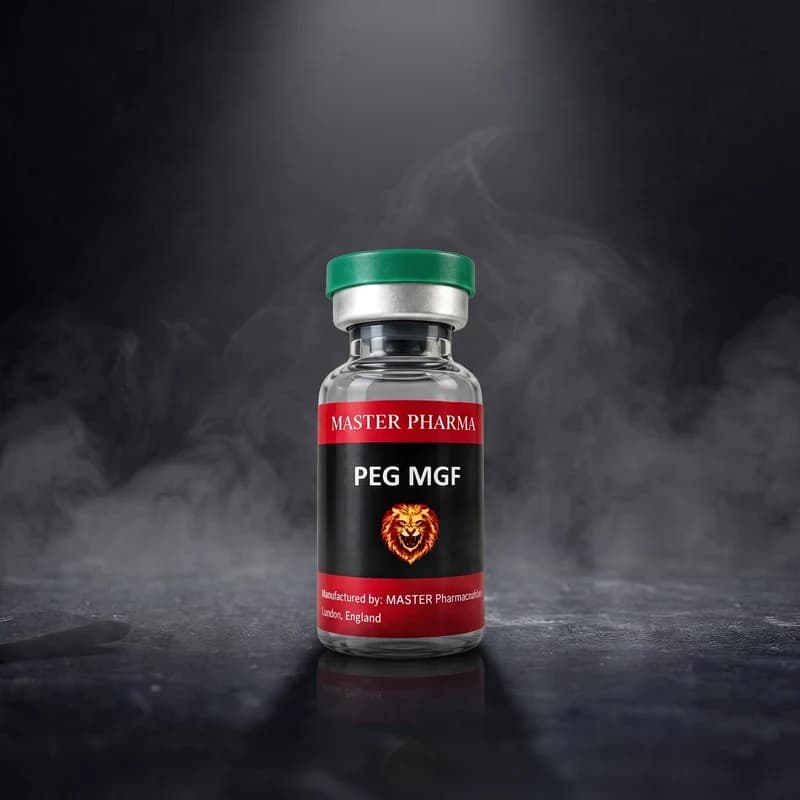
What Is PEG-MGF and How Does PEGylation Change Its Pharmacology?
PEG-MGF (Pegylated Mechano Growth Factor) is a synthetic, chemically modified analogue of Mechano Growth Factor — itself a splice variant of IGF-1 — in which polyethylene glycol (PEG) chains are covalently attached to the MGF peptide backbone to dramatically extend its circulating half-life and systemic bioavailability. Understanding why this modification matters requires a brief look at native MGF. Unmodified MGF is produced locally within muscle tissue in response to mechanical loading or micro-damage; it acts at satellite cells through the IGF-1 receptor (IGF-1R) and a distinct N-terminal domain receptor, stimulating proliferation and self-renewal of muscle progenitor cells before rapidly degrading — with a plasma half-life measured in minutes under physiological conditions. PEG-MGF extends that half-life to approximately 72 hours or longer by shielding proteolytic cleavage sites and reducing renal clearance, allowing systemic administration to deliver the peptide to multiple muscle groups simultaneously rather than relying solely on localised autocrine/paracrine release.
At the receptor level, the C-terminal E-domain of MGF binds the IGF-1R, activating the canonical PI3K/Akt/mTOR signalling cascade responsible for protein synthesis upregulation and anti-apoptotic signalling in myonuclei. Simultaneously, the unique 24-amino-acid N-terminal domain of MGF engages a separate, as-yet incompletely characterised receptor — distinct from the IGF-1R — on satellite cells, promoting their proliferation without inducing premature differentiation. This dual-receptor engagement is what distinguishes MGF from mature IGF-1 itself: whereas IGF-1 drives both proliferation and differentiation, MGF biases the response firmly towards satellite cell expansion, enlarging the pool of progenitor cells available for subsequent muscle fibre accretion. PEGylation preserves both binding domains while conferring stability, making PEG-MGF a pharmacologically distinct entity from native MGF and from standard IGF-1 analogues. Subcutaneous bioavailability of PEGylated peptides in general is well-documented to exceed 80% in preclinical models, representing a substantial improvement over the negligible systemic bioavailability of unmodified MGF administered by the same route.
Application Context, User Groups, and Research Background
Within the research peptide community and among competitive bodybuilders who use peptides as investigational compounds, PEG-MGF occupies a specific and deliberate niche: post-exercise and post-cycle satellite cell recruitment. The fundamental rationale is timing-dependent. When skeletal muscle is subjected to hypertrophic training or recovers from anabolic-androgenic compound cycles, satellite cell activity is the rate-limiting factor in long-term muscle fibre growth. Satellite cells — the resident stem cell population of adult skeletal muscle — must first proliferate before they can donate myonuclei to existing fibres, raising the myonuclear domain and thereby increasing the ceiling for hypertrophy. PEG-MGF addresses precisely this bottleneck.
Experienced researchers and physique athletes who use PEG-MGF typically fall into two broad profiles. The first group comprises those in active hypertrophy phases, using the peptide in the days immediately following high-intensity resistance training sessions to capitalise on the transient window of elevated satellite cell sensitivity. The second group includes those managing post-cycle recovery, where the goal is to preserve and expand the myonuclear gains made during an anabolic phase before natural androgen levels fully normalise. In both cases, the extended half-life of PEG-MGF is a practical advantage: a single or twice-weekly injection schedule replaces what would otherwise require near-daily administration of native MGF to maintain receptor engagement.
Preclinical literature, including studies in rodent models of muscle injury, demonstrates that systemically administered PEG-MGF increases satellite cell number, reduces apoptotic signalling in damaged muscle, and accelerates functional recovery metrics compared with saline controls. Human data remain absent from peer-reviewed literature in a clinical trial context, meaning all application in bodybuilding is extrapolation from animal pharmacology and community-level anecdotal reporting — a distinction that responsible users acknowledge. PEG-MGF is also discussed in the context of injury recovery among athletes in contact sports, where satellite cell-mediated regeneration of damaged fibres is a primary concern. The peptide does not carry the androgenic signalling of AAS and does not suppress the hypothalamic-pituitary-gonadal axis, making it of particular interest to users who want anabolic support without endocrine suppression.
Range & Selection by Concentration and Pack Size
PEG-MGF is offered in a single, standardised concentration tier — 5mg per vial — which reflects the compound's research-established dosing parameters and the practical logistics of lyophilised peptide presentation.
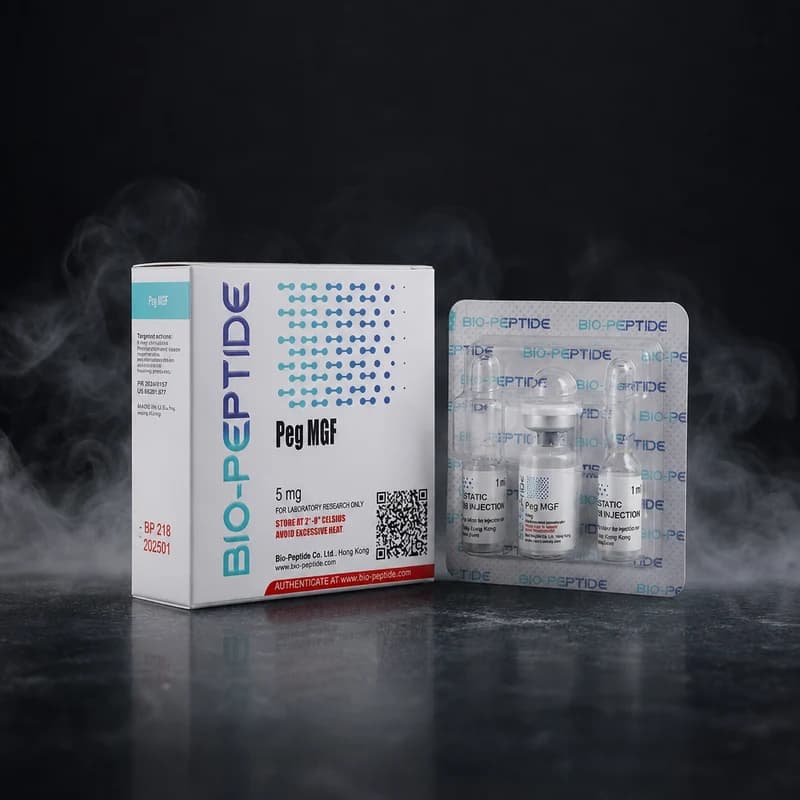
Peg MGF 5mg/vial 1 Vial by Bio-Peptide is the representative and currently sole product within this category. Bio-Peptide is a well-regarded manufacturer within the European research peptide market, known for lyophilised vials that maintain integrity under cold-chain conditions. A 5mg vial provides substantial volume for structured research protocols: at commonly discussed exploratory doses of 200–400 mcg per administration, a single vial represents between 12 and 25 discrete doses, enabling multi-week investigation without repeated restocking. This concentration is appropriate for both introductory protocols and more experienced regimens — there is no lower-concentration introductory tier for PEG-MGF in the way that some peptides offer 2mg options, because the 5mg format accommodates the full dosing spectrum by adjustment of reconstitution volume rather than compound concentration.
Guidance by use case is as follows. For those at the beginning of a PEG-MGF research protocol, reconstituting the vial with a larger volume of bacteriostatic water allows precise extraction of lower per-dose volumes, making microdosing straightforward. For advanced researchers running the peptide alongside growth hormone secretagogues such as GHRP-6 or CJC-1295, the 5mg vial integrates cleanly into a stacked protocol without requiring disproportionate supply management. Researchers investigating IGF-1 pathway augmentation may also wish to cross-reference PEG-MGF with long R3 IGF-1 products to understand their mechanistically complementary but non-overlapping roles in the growth factor cascade.
When selecting PEG-MGF, vial integrity and storage protocol are paramount: lyophilised peptide should be refrigerated pre-reconstitution and used within a defined window post-reconstitution. Bio-Peptide's single-vial pack format ensures that freshness is maintained and waste is minimised, particularly relevant for a compound used intermittently across training cycles.
Frequently Asked Questions
What makes PEG-MGF different from standard MGF or IGF-1?
PEGylation extends MGF's plasma half-life from minutes to approximately 72 hours, enabling systemic administration and multi-muscle-group targeting. Unlike IGF-1, which drives both satellite cell proliferation and differentiation, MGF's unique N-terminal domain biases the response toward satellite cell expansion — PEG-MGF preserves this specificity while adding practical dosing convenience.
How should a 5mg vial of PEG-MGF be reconstituted and stored?
A 5mg vial is typically reconstituted with bacteriostatic water; adjusting the volume allows precise dosing at 200–400 mcg per injection. Prior to reconstitution, store the lyophilised vial refrigerated at 2–8°C. Once reconstituted, use within the manufacturer's recommended window — generally up to 28 days refrigerated — and avoid repeated freeze-thaw cycles to preserve peptide integrity.
Can PEG-MGF be stacked with other peptides?
Yes — PEG-MGF is commonly researched alongside growth hormone secretagogues such as GHRP-6 or CJC-1295, as their mechanisms act on different axes of the growth factor network. Some researchers also explore concurrent use with IGF-1 analogues for complementary downstream signalling. However, individual peptide protocols should be designed with a clear mechanistic rationale rather than additive-by-default stacking.


 Lab Tested