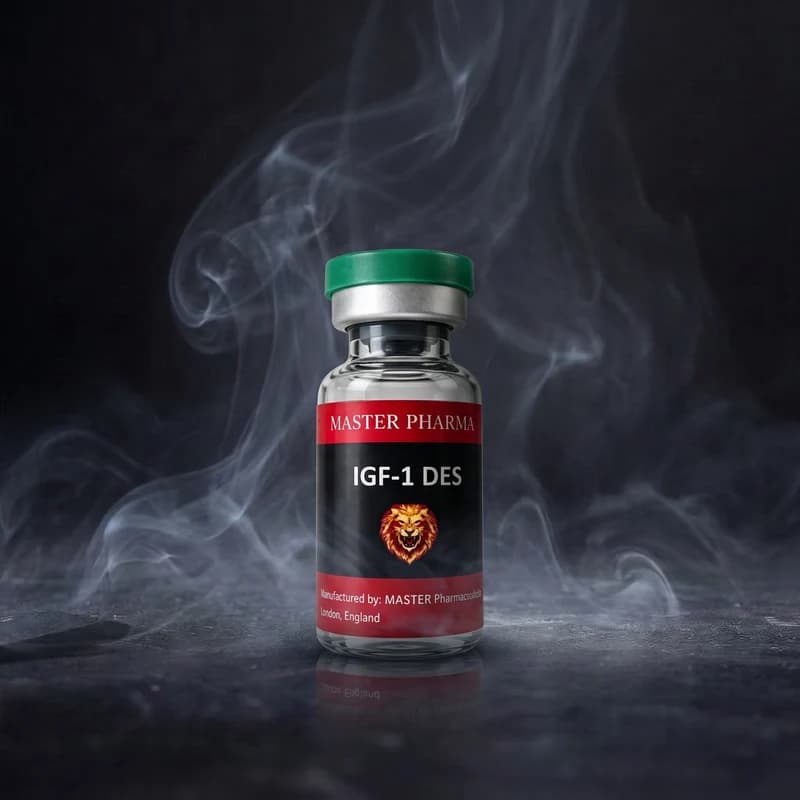
Mechanism & Pharmacology of IGF-1 DES
IGF-1 DES is a naturally occurring, truncated variant of insulin-like growth factor 1 (IGF-1), formed by the deletion of the first three N-terminal amino acids (glutamic acid, leucine, and leucine) to produce the des(1–3) sequence. This structural modification profoundly alters how the peptide interacts with its binding environment. Full-length IGF-1 binds with high affinity to insulin-like growth factor binding proteins (IGFBPs), particularly IGFBP-3, which effectively sequesters a significant proportion of circulating IGF-1 and limits its biological availability at the tissue level. By contrast, IGF-1 DES retains reduced affinity for IGFBPs — estimated at roughly 1,000-fold lower than its parent molecule — meaning that a far greater fraction of the administered peptide remains in free, biologically active form.
Despite this reduced IGFBP affinity, IGF-1 DES binds the IGF-1 receptor (IGF-1R) with potency comparable to, and in some studies slightly exceeding, that of full-length IGF-1. The IGF-1 receptor is a transmembrane tyrosine kinase receptor; IGF-1 DES activates it and triggers downstream phosphorylation of insulin receptor substrate-1 (IRS-1), initiating the PI3K/Akt and MAPK/ERK signalling cascades. These pathways govern cell proliferation, protein synthesis, glucose uptake, and the suppression of apoptosis. Because IGF-1 DES reaches target receptors more efficiently — particularly within local tissue environments — it can produce pronounced anabolic and anti-catabolic responses at the cellular level with relatively modest administered quantities.
The half-life of IGF-1 DES is notably short. Estimates in research contexts typically place it in the range of 20 to 30 minutes in plasma, which contrasts sharply with the hours-long effective half-life of IGFBP-bound full-length IGF-1. This brevity makes IGF-1 DES a highly localised acting peptide: when administered intramuscularly into a specific muscle group, the peptide exerts its effects primarily within that local tissue before being rapidly cleared. Bioavailability via subcutaneous injection is considered reasonable but the intramuscular route is generally preferred in research settings where localised hypertrophic signalling is the endpoint of interest. Molecular weight sits at approximately 7,371 Da, placing it firmly within the peptide range and necessitating reconstitution from lyophilised powder prior to use.
Application Context & User Groups
The interest in IGF-1 DES within applied physiology research and performance-focused communities stems from its unique combination of high local bioactivity and rapid plasma clearance. Because the peptide escapes sequestration by IGFBPs, it can stimulate satellite cell activation and myoblast proliferation in skeletal muscle tissue far more directly than the endogenous full-length hormone under physiological conditions. Satellite cells are the resident stem cells of skeletal muscle, and their activation is a prerequisite for meaningful muscle fibre hypertrophy and repair following resistance training stimulus. IGF-1 DES promoting satellite cell activity makes it particularly attractive to researchers examining muscular regeneration and growth signalling.
Within the bodybuilding and strength sports community, IGF-1 DES is most commonly associated with protocols aimed at site-specific muscle development. The peptide's short half-life concentrates its effect locally, which is precisely why advanced users in research contexts tend to time administration immediately post-training, targeting the worked muscle group directly. This approach is intended to amplify the anabolic signalling window that naturally follows resistance exercise — a window characterised by elevated IGF-1R sensitivity and heightened IRS-1 phosphorylation capacity.
User groups who engage with IGF-1 DES in research and performance contexts typically include experienced practitioners already familiar with peptide reconstitution, storage, and administration protocols. The compound is not considered an entry-level peptide. Researchers and competitive athletes in bodybuilding, powerlifting, and physique sports represent the primary end-use categories, and IGF-1 DES is frequently examined alongside growth hormone secretagogues, long-acting IGF-1 variants such as IGF-1 LR3, and insulin-potentiating compounds. Its role is generally that of a precise, short-duration amplifier of local anabolic signalling rather than a systemic hormonal driver — a distinction that shapes how it is positioned relative to other peptides within comprehensive research stacks.
Clinical research into IGF-1 DES has also touched on its potential relevance in muscle wasting conditions. Studies examining the des(1–3) IGF-1 variant have noted its superior potency in promoting nitrogen retention and cellular proliferation compared to standard IGF-1 in certain in vitro and animal model settings, lending additional scientific credibility to the interest it receives from the performance research community.
Range & Selection by Concentration and Pack Size
The current selection of IGF-1 DES available in this category comprises two products, both standardised at the research-typical concentration of 1mg per vial, supplied as single-vial packs of lyophilised powder. This concentration tier — 1mg/vial — represents the standard format for IGF-1 DES in the peptide research market and is well-suited to short-duration protocols where precise, measured dosing is essential.
Des (1-3) IGF 1mg/vial 1 Vial by Bio-Peptide is manufactured by Bio-Peptide, a supplier recognised within the research peptide sector for pharmaceutical-grade lyophilisation and consistent purity standards. Bio-Peptide's presentation in single-vial format makes this product appropriate for researchers undertaking focused, well-controlled protocols where cross-contamination between storage sessions is minimised by single-use supply.
IGF-1 DES 1mg/vial 1 Vial by Knoll Pharmaceuticals is produced by Knoll Pharmaceuticals, offering the same 1mg concentration within a comparable single-vial format. Knoll Pharmaceuticals brings established manufacturing credibility to this product, and the clean, clearly labelled specification makes it a practical choice for researchers who require verifiable sourcing and consistent lot quality.
At the 1mg/vial tier, both products are suited to users with an existing understanding of peptide reconstitution using bacteriostatic water, careful measurement via insulin syringe, and cold-chain storage protocols (typically 2–8°C for reconstituted peptide, with lyophilised vials stable at controlled room temperature prior to reconstitution). Researchers seeking extended protocol durations may consider purchasing multiple single-vial units rather than expecting a single vial to cover multi-week research windows — particularly given IGF-1 DES's position as a localised, frequently-administered compound in most published research contexts.
Frequently Asked Questions
What distinguishes IGF-1 DES from standard IGF-1 LR3?
IGF-1 DES is a truncated variant with dramatically reduced binding affinity for insulin-like growth factor binding proteins, making more of the peptide immediately bioavailable at the tissue level. IGF-1 LR3 is an extended analogue with a prolonged half-life of around 20–30 hours. DES acts locally and briefly; LR3 produces more systemic, sustained IGF-1 receptor stimulation over a longer period.
Why is the 1mg/vial format the standard for IGF-1 DES research?
IGF-1 DES is typically studied at relatively modest per-administration quantities, and the 1mg/vial format aligns with the granular dosing precision required in short-duration, localised protocols. Single-vial packs also support fresh reconstitution practices, which help preserve peptide stability and reduce degradation risk — important given IGF-1 DES's sensitivity to temperature and repeated freeze-thaw cycles.
Which user profile is IGF-1 DES most appropriate for in a research context?
IGF-1 DES is best suited to experienced researchers and advanced practitioners already proficient in peptide handling, reconstitution, and intramuscular administration techniques. Due to its specific mechanism — localised IGF-1 receptor activation with rapid plasma clearance — it is typically explored by individuals with a clear research objective around muscle satellite cell activation or site-specific hypertrophic signalling.


 Lab Tested