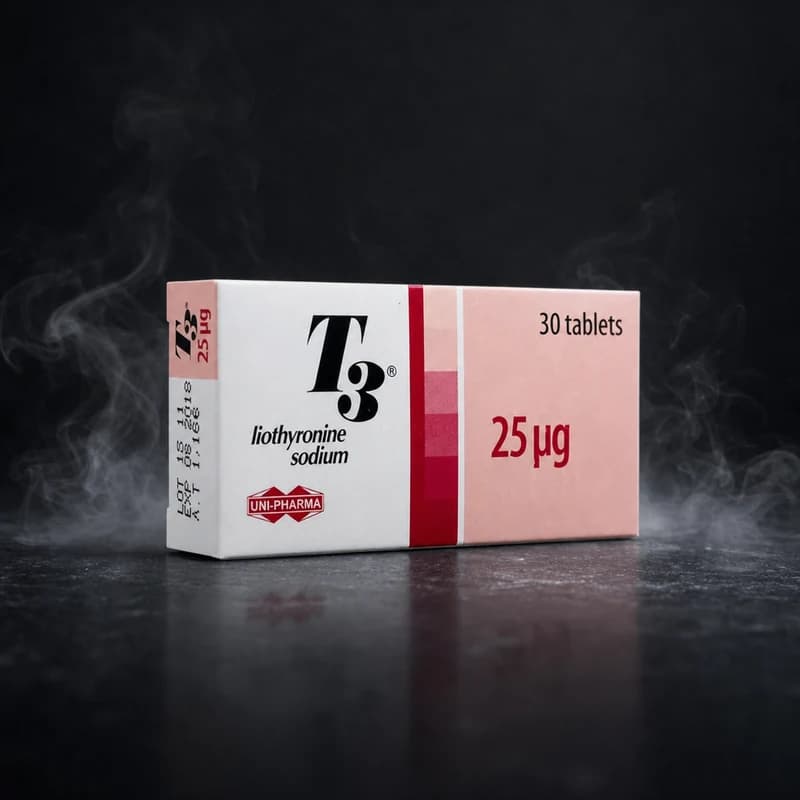
T3 Liothyronine is a synthetically produced form of triiodothyronine, the biologically active thyroid hormone that governs basal metabolic rate, thermogenesis, and the cellular utilisation of macronutrients across virtually every tissue in the body.
Mechanism & Pharmacology of T3 Liothyronine
Liothyronine exerts its primary effects by binding thyroid hormone receptor isoforms TRα and TRβ, which are ligand-activated transcription factors residing in the cell nucleus. Once the hormone-receptor complex is formed, it interacts with thyroid hormone response elements on DNA, directly upregulating the transcription of genes involved in energy expenditure, mitochondrial biogenesis, and substrate oxidation. Triiodothyronine binds these receptors with approximately three to four times the affinity of thyroxine (T4), which explains why T3 — rather than T4 — is considered the metabolically active species and why its synthetic exogenous form is the preferred choice when rapid, predictable action is required.
Oral liothyronine is rapidly absorbed from the gastrointestinal tract, with bioavailability estimated between 93 and 100%, making it one of the most completely absorbed oral pharmaceuticals available. Peak serum concentrations are reached within two to four hours of ingestion. The elimination half-life is approximately one to two days (commonly cited as 18–24 hours), considerably shorter than the roughly seven-day half-life of levothyroxine (T4). This shorter half-life confers both an advantage and a responsibility: dose titration produces visible metabolic effects within days, but abrupt cessation or missed doses equally produce rapid changes in thyroid status. The enzyme type I iodothyronine deiodinase normally converts endogenous T4 to T3 in peripheral tissues; exogenous liothyronine bypasses this conversion entirely, delivering a direct hormonal signal without dependence on enzymatic activity or iodine availability.
At the cellular level, elevated T3 concentrations increase the activity of Na⁺/K⁺-ATPase, raising the baseline energy cost of maintaining ionic gradients. Uncoupling protein (UCP) expression is also stimulated, shifting mitochondrial respiration towards heat production rather than ATP synthesis — the biochemical basis of the thermogenic effect that bodybuilders and physique athletes seek to exploit during caloric restriction phases.
Application Context & User Groups
In clinical endocrinology, liothyronine is prescribed for hypothyroidism and, in combination with thalidomide protocols, for certain thyroid cancers, with standard replacement doses typically ranging from 25–75mcg per day. In the bodybuilding and physique sports context, T3 occupies a distinct role: it is almost exclusively employed during cutting phases with the objective of raising basal metabolic rate sufficiently to accelerate fat loss beyond what diet and training alone can achieve, even in athletes already operating at a significant caloric deficit.
Because exogenous T3 suppresses the hypothalamic-pituitary-thyroid axis through negative feedback — the pituitary gland detects elevated circulating T3 and reduces thyroid-stimulating hormone (TSH) secretion, subsequently dampening endogenous thyroid output — responsible use involves a structured titration approach. Experienced users commonly begin at 25mcg per day, assess tolerance over one to two weeks, and increase incrementally to a maximum of 75–100mcg per day only if lower doses prove insufficient. Cycle durations are generally kept to six to eight weeks, after which a gradual taper rather than abrupt discontinuation is employed to allow the HPT axis to re-establish normal function without precipitating a rebound hypothyroid state.
T3 liothyronine is frequently used in conjunction with anabolic agents during competition preparation. The rationale is well-grounded: the catabolic potential of elevated T3 — which accelerates protein turnover alongside fat oxidation — is substantially mitigated when circulating androgen levels are supraphysiological, as androgens exert a protein-sparing effect by promoting muscle protein synthesis and reducing myofibrillar degradation. Competitive bodybuilders, physique athletes preparing for shows, and advanced users in extended caloric restriction phases constitute the primary audience for this compound. It is less commonly used by beginners, given the precision required in dose management and the systemic consequences of hyperthyroid states — including tachycardia, tremor, and accelerated bone resorption — if doses are not carefully controlled.
Range & Selection by Concentration and Pack Size
This category currently offers nine products sourced from nine distinct manufacturers, spanning three concentration tiers: 25mcg per tablet, 50mcg per tablet, and 100mcg per tablet. This breadth makes it straightforward to match product selection to experience level and intended daily dose without requiring tablet splitting.
25mcg per tablet products represent the most accessible entry point and the logical choice for users beginning their first T3 cycle or those who prefer granular control over incremental dose increases. Two strong options at this tier are Tiromel by Abdi Ibrahim — a long-established Turkish pharmaceutical product with a reliable manufacturing history — offered in 100-tablet packs providing substantial supply, and ThyroTrex by Concentrex Labs, also dosed at 25mcg per tablet in a 100-tablet format. The 25mcg tablet allows a starting protocol of one tablet daily, with straightforward progression to two or three tablets as tolerance is assessed. T3-Liothyronine Sodium by Hilma Biocare offers the same 25mcg dose in a 50-tablet pack, which suits shorter cycles or users who prefer to purchase smaller quantities initially.
50mcg per tablet products are suited to intermediate users who have already established their optimal dose and wish to reduce daily tablet count. Cytomel-T3 by Beligas Pharmaceuticals provides 50mcg tablets in a 50-tablet pack — a practical combination for a four- to five-week cycle at 50mcg daily, or a shorter run at higher doses. T3 by Genesis offers 50mcg tablets in a larger 100-tablet pack, providing more flexibility for extended protocols or a staged dose-escalation approach within a single purchase.
100mcg per tablet is the highest concentration tier available in this range and is appropriate for advanced users who have accurately determined through prior cycles that their effective dose sits at or near 100mcg per day. T3 – Cytomel by LA Pharma, dosed at 100mcg per tablet in a 100-tablet pack, exemplifies this tier. At this concentration, careful halving of tablets may be necessary for those targeting intermediate doses, so users should factor this into their planning. This tier is not recommended as an entry point given the precision required in dosing and the minimal margin for inadvertent overdosing.
Across all tiers, the standard pharmaceutical guidance of beginning low and titrating upward applies with particular relevance to liothyronine, given its direct and potent effect on systemic metabolic rate.
Frequently Asked Questions
What is the difference between T3 Liothyronine and T4 Levothyroxine for bodybuilding purposes?
T3 Liothyronine is the biologically active thyroid hormone that directly binds thyroid receptors, producing metabolic effects within hours. T4 Levothyroxine must be converted to T3 by peripheral deiodinase enzymes before it becomes active. For physique purposes, T3 is preferred because its effects are faster, more predictable, and do not depend on conversion efficiency, which can vary between individuals.
How should T3 Liothyronine be dosed for a cutting cycle?
Most experienced users begin at 25mcg per day, evaluate tolerance for one to two weeks, then increase by 25mcg increments as needed, with many finding 50–75mcg sufficient. Cycles typically last six to eight weeks. A gradual taper at the end is advised to allow the hypothalamic-pituitary-thyroid axis to resume normal TSH secretion and avoid a rebound hypothyroid period.
Does T3 cause muscle loss during a cutting phase?
Elevated T3 does accelerate protein turnover alongside fat oxidation, which can contribute to muscle catabolism if used without adequate protein intake and anabolic support. Concurrent use with anabolic compounds, sufficient dietary protein (typically above 2g per kg of bodyweight), and resistance training substantially reduces this risk. Solo T3 use during aggressive deficits carries a higher risk of lean tissue loss.


 Customer Favorite