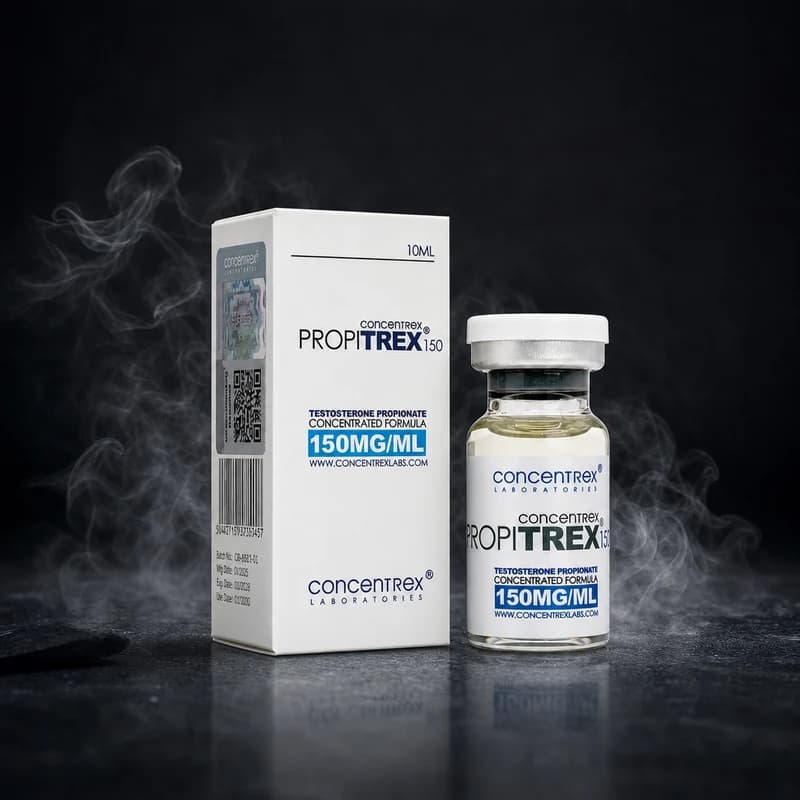
Testosterone Propionate as an Androgen Receptor Agonist: What GenTec Test-P 150 Actually Does
GenTec Test-P 150 is an oil-based injectable steroid in which Testosterone Propionate — testosterone attached to a short propanoic acid ester — functions as a direct, high-affinity agonist of the intracellular androgen receptor (AR). The free testosterone liberated after ester hydrolysis binds the AR's ligand-binding domain with a dissociation constant (Kd) in the low nanomolar range, matching the affinity of endogenous testosterone measured in human myocyte studies. This receptor occupancy triggers nuclear translocation of the AR-ligand complex, where it engages androgen-response elements (AREs) on target gene promoters to upregulate contractile protein synthesis, erythropoietic signalling, and satellite-cell recruitment.
DHT Conversion and Tissue-Specific Receptor Activation
Testosterone itself is a partial substrate for 5-alpha reductase (5αR), and a meaningful proportion of circulating free testosterone undergoes intracellular conversion to dihydrotestosterone (DHT) in androgen-sensitive tissues. DHT binds the androgen receptor with approximately three times the affinity of testosterone as established in competitive radiobinding assays, producing amplified transcriptional output in tissues rich in 5αR — notably skeletal muscle, skin, and the prostate. Compared to non-5αR-substrate androgens such as nandrolone, testosterone propionate therefore generates a broader tissue-level androgenic signal, including full androgenic drive in neural tissue where DHT concentration correlates with motivation and recovery signalling.
AR Transactivation Kinetics and the 150mg/ml Concentration Advantage
Testosterone propionate's ester is cleaved by plasma and tissue esterases within hours of intramuscular deposition, releasing bioavailable free testosterone that reaches peak plasma concentration within 24–36 hours post-injection (pharmacokinetic data referenced from classical Testosterone Propionate PK studies, e.g., Nieschlag & Behre, Testosterone: Action, Deficiency, Substitution, 4th ed.). GenTec Test-P 150 supplies this free testosterone pulse at 150mg/ml — meaning a 1ml injection delivers a dose that would require 1.5ml from a standard 100mg/ml preparation. Reduced injection volume per dose lowers the oil-vehicle bolus deposited intramuscularly, a relevant consideration for users managing injection-site tolerance across multi-week protocols.
Three core semantic facts govern the mechanism: free testosterone activates the androgen receptor directly in skeletal muscle cells; 5-alpha reductase converts testosterone to DHT for amplified AR binding in specific tissues; and sustained AR occupancy drives anabolic gene expression via ARE-mediated transcription. These are not additive effects but sequential steps in a single receptor-signalling cascade — understanding them allows practitioners to anticipate both the anabolic outcomes and the androgenic side-effect profile associated with Test-P 150 precisely.

 Established Brand