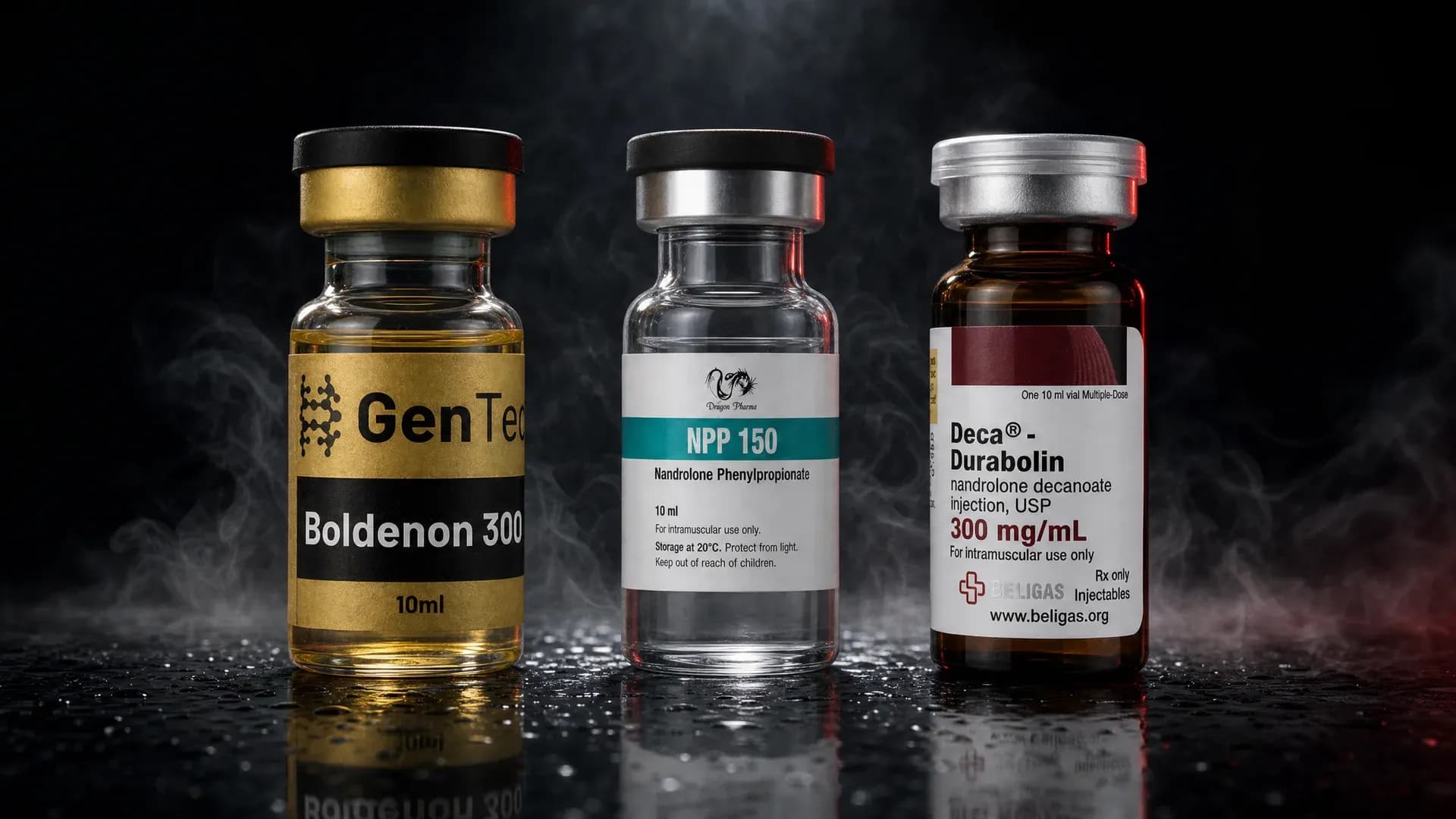
Nandrolone Decanoate (Deca): The Complete Cycle Guide
Planning a nandrolone decanoate cycle? This guide covers dosing, injection frequency, cycle length, prolactin and progestin risks, and why Deca requires a testosterone base plus delayed PCT.
Nandrolone Decanoate (Deca): The Complete Cycle Guide
TL;DR
- Nandrolone decanoate is a long-ester 19-nor injectable with a half-life of roughly 6–12 days; one to two injections per week are sufficient for stable blood levels.
- The standard dose range is 200–400 mg per week, almost always run alongside a testosterone base — never as a standalone compound.
- Because the decanoate ester saturates slowly, cycles typically run 10–14 weeks; noticeable effects arrive around weeks 4–6.
- Nandrolone aromatises far less than testosterone but acts as a progestin and can elevate prolactin — this drives its characteristic risks: sexual dysfunction, gynecomastia, and prolonged suppression.
- PCT starts approximately three weeks after the last injection, later than with testosterone enanthate, and recovery from nandrolone is often slower and less certain.
- Bloodwork must include prolactin alongside the standard hormone, lipid, and haematology panels — nandrolone without monitoring is a gamble, not a cycle.
What Nandrolone Decanoate Is
Nandrolone decanoate is nandrolone — a 19-nortestosterone molecule, meaning testosterone with the carbon at position 19 removed — bound to the decanoate ester, a ten-carbon fatty acid chain that produces one of the slowest release profiles of any commonly used injectable. The 19-nor modification changes the compound's behaviour in three important ways: it aromatises to oestradiol at roughly a fifth of testosterone's rate, it binds and activates the progesterone receptor, and it reduces to dihydronandrolone (DHN) rather than the more potent dihydrotestosterone (DHT) in androgen-sensitive tissue.
Its anabolic-to-androgenic ratio is commonly cited around 125:37, which is why it built a reputation for producing quality muscle with comparatively mild acne and hair-loss sides. Nandrolone also has a genuine clinical history — it was used for decades in European medicine for anaemia, osteoporosis, and wasting conditions — so its pharmacology is better documented than most grey-market compounds. If you are weighing nandrolone against its shorter-ester cousin NPP or against boldenone, the ester kinetics and effect differences are mapped out in Equipoise Vs DECA Vs NPP Boldenone And Nandrolone Esters Compared.
One property deserves emphasis before anything else: nandrolone and its metabolites are detectable in doping controls for many months — in some cases well over a year — after the last injection. For tested athletes, that alone ends the discussion.
Effects and What to Realistically Expect
Nandrolone produces steady, quality-tissue gains rather than the rapid scale jumps of highly aromatising compounds. Expect a gradual increase in bodyweight over weeks 4–10, a good portion of it intracellular water and glycogen alongside genuine contractile tissue, with strength climbing moderately rather than explosively.
Two effects are widely reported and deserve honest framing. First, the "joint relief" effect: many users report reduced joint pain and improved training comfort on nandrolone, plausibly via increased water retention in connective tissue and effects on collagen synthesis. Treat this as a masking effect, not a healing effect — the underlying tendon or joint problem is still there, and lifting through it because the pain signal is muted is a reliable way to turn a niggle into an injury. Second, nandrolone's low androgenicity in skin and scalp does not mean zero androgenicity: genetically predisposed users can still lose hair, and the compound is not a "safe" choice for the baldness-prone, merely a less aggressive one than DHT-derivatives.
Dosage and Cycle Protocol
Dose-response with nandrolone flattens quickly. The compound earns its reputation at 200–400 mg per week; above that, side-effect burden — prolactin, blood pressure, suppression depth, lipid damage — climbs faster than gains do.
Experience level | Weekly nandrolone dose | Testosterone base | Injections per week |
|---|---|---|---|
Beginner | 200–300 mg | 300–500 mg | 1–2 |
Intermediate | 300–400 mg | 400–600 mg | 2 |
Advanced | 400–600 mg | 500–750 mg | 2 |
Two rules govern the protocol. First, always run a testosterone base. Nandrolone suppresses the HPT axis hard and converts to DHN rather than DHT, leaving some tissues — particularly those involved in libido and erectile function — short of androgenic signalling. Running nandrolone alone ("deca only") is the classic recipe for the sexual dysfunction the compound is infamous for. Common practice keeps testosterone at least equal to the nandrolone dose, and many experienced users run testosterone higher. Second, commit to the full length: because the decanoate ester takes four to five weeks to reach steady state, cycles under ten weeks waste most of the saturation phase.
Week | Nandrolone decanoate | Testosterone base | Supporting actions |
|---|---|---|---|
0 | — | — | Baseline bloodwork incl. prolactin; blood pressure |
1–12 | 200–400 mg/week | 300–500 mg/week | Training and diet dialled in |
6–7 | — | — | Mid-cycle bloodwork: hormones, E2, prolactin, lipids, haematocrit |
13–15 | None | None | Ester clearance — nandrolone declines over ~3 weeks |
16–20 | PCT | — | SERM protocol (see PCT section) |
22+ | — | — | Post-PCT bloodwork to confirm recovery |
Pharmaceutical-grade nandrolone has historically been supplied at relatively low concentrations, which matters for injection volume: Nandrolone Decanoate 100mg/ml 1x2ml Ampoules by Norma Hellas at 100 mg/ml means a 300 mg week is 3 ml of oil split across two injections, while a higher-concentration preparation such as Nandrolone Decanoate 200mg/ml 10x1ml Ampoules by Pharm-Tec halves that volume. Concentration, not the ester, is what changes here — 200 mg of nandrolone decanoate is 200 mg regardless of the vial it came from. The available preparations are grouped in the Nandrolone Decanoate category.
Side Effects and Risks
Nandrolone's side-effect profile is distinct from testosterone's and is systematically underestimated because it aromatises less. The real risk centres are:
- Suppression, deep and long. Nandrolone shuts down natural testosterone production within weeks and, because the ester lingers, the suppressive tail extends for weeks after the last shot. Recovery from nandrolone-containing cycles is consistently reported as slower and less reliable than from testosterone-only cycles — a meaningful argument against using it early in your "career."
- Prolactin and progesterone activity. Nandrolone activates the progesterone receptor and can elevate prolactin, particularly when oestradiol from the testosterone base is also high. The consequences — gynecomastia that can appear despite low oestrogen, lactation in rare cases, and blunted libido — are the signature problems of the 19-nor family.
- Sexual dysfunction. "Deca dick" is not a myth but a mechanism: suppressed endogenous androgens, DHN replacing DHT in erectile tissue, and elevated prolactin all push in the same direction. A testosterone base lowers the risk; it does not eliminate it.
- Cardiovascular strain. HDL suppression is often worse on nandrolone than on equivalent testosterone doses, and haematocrit and blood pressure drift upward over a long cycle. Combined with 12+ weeks of exposure, the cumulative cardiovascular cost is real.
- Mental and mood effects. Anecdotal reports of low mood, apathy, or anxiety during and after nandrolone cycles are common enough to take seriously, plausibly linked to altered neurosteroid balance. Anyone with a history of depression should weigh this carefully.
Bloodwork and Monitoring
The monitoring framework for nandrolone mirrors any injectable cycle, with one addition that is not optional: prolactin. The minimum panel at baseline, mid-cycle (week 6–7), and post-PCT includes total and free testosterone, LH and FSH, sensitive oestradiol, prolactin, a full lipid panel, liver enzymes, haematocrit and haemoglobin, plus twice-weekly home blood pressure readings. If mid-cycle prolactin comes back elevated alongside symptoms — libido loss, nipple sensitivity, low mood — that is actionable information you cannot get any other way; guessing from symptoms alone misidentifies the cause as often as it catches it. Marker-by-marker reference ranges and the reasoning behind each test are laid out in Blood Tests On A Steroid Cycle 12 KEY Markers Reference Values.
If bloodwork shows genuinely elevated prolactin, dopamine agonists such as cabergoline exist — but they carry their own side-effect profile (nausea, orthostatic hypotension, impulse-control issues at higher doses) and are a correction tool for a confirmed lab value, not a prophylactic to swallow from week one. The first-line response to elevated prolactin on a moderate cycle is usually reducing the nandrolone dose or improving oestradiol control, not adding another drug.
PCT After a Nandrolone Cycle
Timing PCT after deca is where most protocols go wrong. The decanoate ester keeps releasing for weeks, and starting SERMs while exogenous nandrolone is still suppressive wastes the attempt. The standard practice is to wait approximately three weeks after the last injection before beginning PCT — some conservative protocols stretch this to four.
A typical protocol then runs four to six weeks with a SERM such as tamoxifen at 20 mg/day or enclomiphene at 12.5–25 mg/day. Recovery must be verified, not assumed: post-PCT bloodwork three to four weeks after the protocol ends (LH, FSH, total testosterone, and ideally prolactin) tells you whether the axis has restarted. Expect recovery from a nandrolone cycle to be slower than from testosterone alone, and plan your next steps — including a long honest off-period — around that reality.
FAQ
Do I really need testosterone with deca?
Yes, in practice. Nandrolone suppresses natural testosterone completely while providing weaker androgenic signalling in tissues that depend on DHT — including those responsible for libido and erectile function. Running it without a testosterone base is the most common cause of the sexual dysfunction and flat mood the compound is known for. Most experienced users keep testosterone at least equal to the nandrolone dose, frequently higher. A "deca-only" cycle is a mistake, not a strategy.
How long does deca take to kick in?
The decanoate ester reaches steady-state blood levels around weeks four to five, and most users report clear training effects — fuller muscles, rising strength, shorter recovery — between weeks four and six. If you feel nothing by week seven at a reasonable dose, bloodwork is the way to check whether the product is underdosed rather than simply escalating the dose. This slow onset is precisely why cycles under ten weeks make little sense with this ester.
Is deca actually good for your joints?
It reliably reduces joint pain for many users, but the honest interpretation is that it masks symptoms rather than repairs tissue. Increased water retention in connective structures and possible effects on collagen synthesis dampen pain signals while the underlying issue — tendinopathy, cartilage wear, poor mechanics — remains. The danger is training heavier through an injury because it no longer hurts. Treat improved joint comfort as a reason to train sensibly, not as a licence to ignore load management.
How long is nandrolone detectable in drug tests?
Far longer than most compounds. Nandrolone metabolites — particularly 19-norandrosterone — can be detected in urine for many months after the last injection, and with long esters and repeated cycles, detection windows beyond a year have been documented. Any athlete subject to anti-doping testing should treat nandrolone as effectively permanent for competitive purposes. No clearance trick, calculator, or timeline makes this risk manageable for a tested athlete.
Can I prevent prolactin problems with cabergoline from the start?
Prophylactic cabergoline is not recommended. Dopamine agonists carry meaningful side effects — nausea, blood-pressure drops, and at higher doses impulse-control disorders — and most moderate nandrolone cycles never produce clinically relevant prolactin elevation. The rational sequence is: keep doses moderate, control oestradiol by bloodwork, test prolactin mid-cycle, and intervene only if a lab value plus symptoms justifies it. Adding drugs to pre-empt problems you have not measured is how manageable cycles become pharmaceutical piles.
Is deca or NPP better for a first nandrolone experience?
NPP — nandrolone phenylpropionate — delivers the same hormone with a much shorter ester, meaning faster onset and, critically, faster clearance if side effects appear. For someone unsure how they respond to 19-nor compounds, the ability to stop and be clear within a week rather than a month is a genuine safety advantage. The trade-off is more frequent injections. Nandrolone decanoate suits longer, planned cycles once your response is known.
Conclusion
Nandrolone decanoate is neither the gentle mass-builder of forum folklore nor an unmanageable risk — it is a long-ester 19-nor compound with a specific, predictable risk profile: hard and prolonged suppression, progestogenic and prolactin-related side effects, sexual dysfunction without a testosterone base, real cardiovascular cost over long cycles, and detection windows that end tested athletes' participation. The workable protocol is unglamorous: 200–400 mg per week alongside at least an equal dose of testosterone, ten to twelve weeks, bloodwork including prolactin at baseline and mid-cycle, a three-week clearance gap, and a verified PCT. Do not run it if you are under roughly 25, if you are subject to drug testing, if your baseline lipids, blood pressure, or mental health are already problems, or if you cannot commit to the monitoring. Nandrolone rewards patience and punishes improvisation — the users who keep their health and their gains are the ones who treat bloodwork as part of the cycle rather than an optional extra.