Wolverine Stack 2026: BPC-157 + TB-500 Science, Protocols & FDA Update
BPC-157 and TB-500 target complementary healing pathways via VEGF and G-actin mechanisms.
Wolverine Stack 2026: BPC-157 + TB-500 Science, Protocols & FDA Update
TL;DR- BPC-157 and TB-500 target complementary healing pathways via VEGF and G-actin mechanisms.- Biçer et al. (2026) found the combination no superior to either peptide alone in tendon repair.- FDA removed both peptides from the 503A Category 2 list in April 2026 — not an approval.- WADA prohibits both under S0/S2 — tested athletes must avoid entirely.- Community protocols run 4–8 weeks; product purity is the single biggest documented risk factor.- No long-term human safety data exists; angiogenic potential warrants caution in oncology contexts.
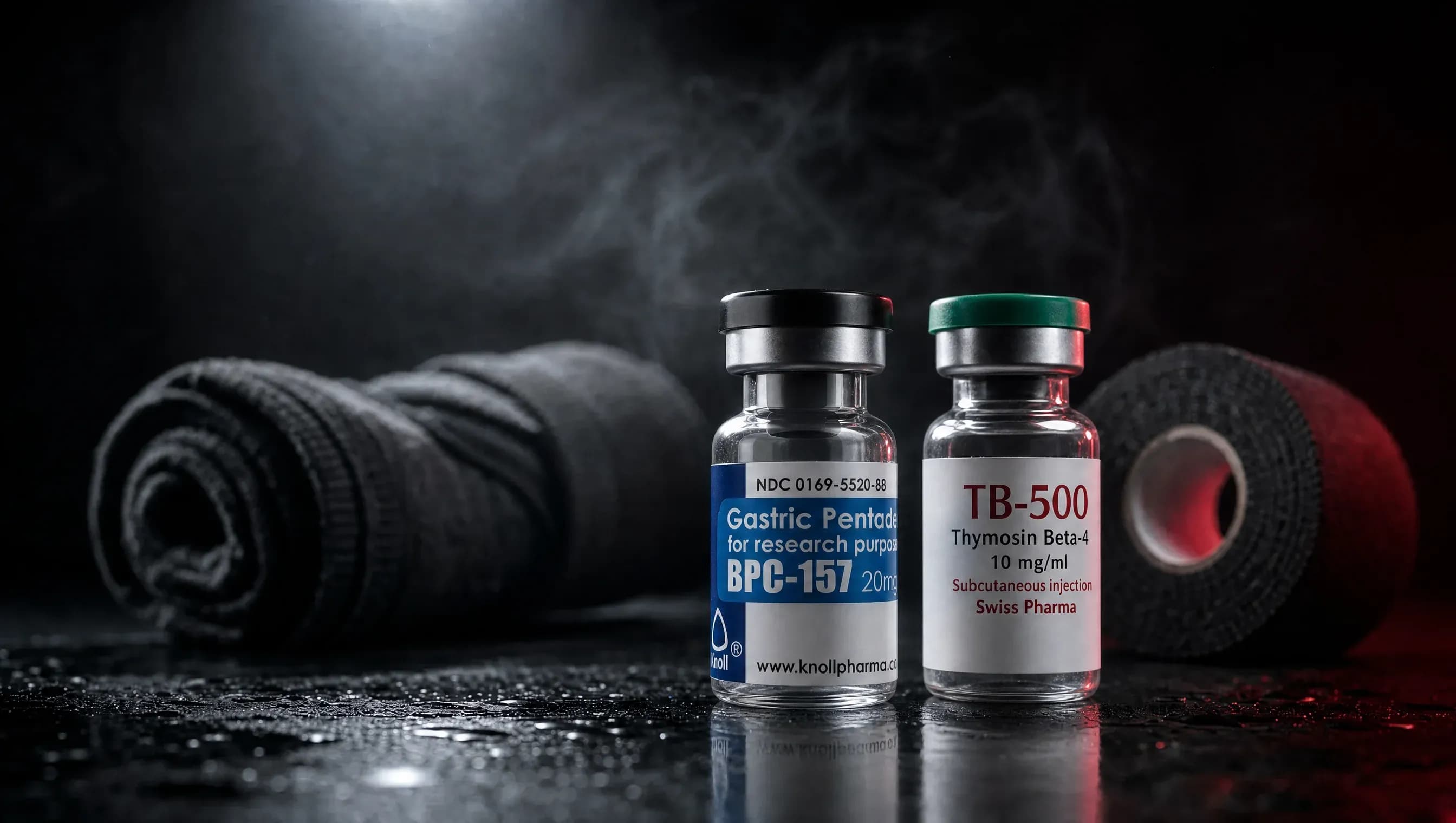
The Wolverine Stack is a combined peptide protocol pairing BPC-157 — a synthetic 15-amino-acid pentadecapeptide derived from a gastric cytoprotective protein — with TB-500, a stabilised analogue of the naturally occurring 43-amino-acid signalling protein Thymosin Beta-4. The nickname references Marvel's self-regenerating mutant, and the premise is mechanistically coherent: BPC-157 acts at the injury site through local vascular and fibroblast pathways, while TB-500 drives systemic cellular migration and remodelling. As of August 2026, new comparative trial data, a significant FDA regulatory shift, and a maturing body of preclinical evidence give us the clearest picture yet of what this stack actually delivers — and where the marketing still outpaces the science.
Mechanism and Pharmacology: How Each Peptide Works
Understanding why these two peptides are stacked together requires examining their distinct molecular mechanisms.
BPC-157 (Body Protection Compound 157, sequence: Gly-Glu-Pro-Pro-Pro-Gly-Lys-Pro-Ala-Asp-Asp-Ala-Gly-Leu-Val) upregulates vascular endothelial growth factor (VEGF) and nitric oxide synthase (eNOS), stimulating angiogenesis and fibroblast proliferation at the injury site. It also modulates the dopaminergic and serotonergic systems via VDBP (vitamin D-binding protein) pathways, which may partly explain systemic effects reported anecdotally. Subcutaneous bioavailability is considered high in rodent models; human pharmacokinetic data remains absent from the published literature.
TB-500 works through a fundamentally different mechanism. Thymosin Beta-4 binds G-actin (monomeric actin) via its LKKTET peptide motif, sequestering it and thereby enabling rapid cytoskeletal remodelling. This promotes keratinocyte and endothelial cell migration, accelerates dermal and connective tissue repair, and modulates inflammatory signalling via NF-κB downregulation. TB-500's longer effective half-life relative to BPC-157 — estimated at 24–72 hours based on Tβ4 analogue data — supports its typical twice-weekly dosing schedule.
The theoretical synergy: BPC-157 triggers local vascular ingrowth and fibroblast recruitment; TB-500 mobilises systemic progenitor cells and directs migration to the remodelling zone. Local plus systemic — each phase of tissue healing theoretically covered.
What the 2026 Research Actually Shows
The most consequential piece of new evidence comes from Biçer and colleagues, published in Joint Diseases and Related Surgery (2026), representing the first head-to-head comparison of BPC-157, TB-500, and their combination in a controlled tendon injury model (surgically transected rat Achilles tendon).
Key findings:
- TB-500 monotherapy produced the strongest results on maximum tensile load and histological degeneration scores.
- BPC-157 monotherapy showed significant improvement over saline controls.
- The combination group was not statistically superior to TB-500 alone on any primary endpoint.
The authors hypothesise convergent downstream signalling — both peptides ultimately promote VEGF-mediated angiogenesis and collagen type-I deposition, possibly creating a ceiling effect rather than additive benefit. This directly challenges the "1+1=3" logic underpinning the stack's popularity.
For broader human data context, TB-500 has the stronger clinical dossier. RegeneRx Biopharmaceuticals completed Phase II trials in venous stasis ulcers (NCT00832091) and conducted Phase I/II work in dry eye disease and cardiac repair, establishing a reasonable short-term safety profile. BPC-157's only registered human trial was halted before completion in 2016, leaving a meaningful evidence gap for systemic or musculoskeletal indications.
The April 2026 FDA Regulatory Shift: What It Means
In April 2026, the FDA removed both BPC-157 and TB-500 from its 503A Bulk Drug Substances Category 2 list — the list of substances under evaluation for compounding pharmacy use. Removal from Category 2 does not constitute approval; it signals the conclusion of the review cycle and clears the path for the Pharmacy Compounding Advisory Committee (PCAC) to issue a formal recommendation on compounding eligibility.
For UK and European customers, the regulatory landscape is unchanged: both peptides remain unlicensed research chemicals with no approved medical indication under EMA frameworks or MHRA guidance. Import for personal use exists in a legal grey zone that varies by jurisdiction.
Critically, the FDA's accompanying statement flagged immunogenicity risk from aggregated peptide impurities and endotoxin contamination in grey-market products — not from the peptides themselves when manufactured to pharmaceutical standards. This distinction matters enormously for harm reduction. Verified quality markers to look for include:
- HPLC purity certificates (≥98% target)
- LAL (Limulus Amebocyte Lysate) endotoxin testing results per batch
- Documented sterility testing for injectable-grade products
Dosing Protocols and Practical Administration
The following reflects community-reported protocols only — these are not clinical recommendations and no prescribing guidance is implied.
Parameter | BPC-157 | TB-500 |
|---|---|---|
Typical dose | 250–500 mcg/day | 2–5 mg per session |
Frequency | Daily | 1–2× per week |
Route | Subcutaneous (near injury site) | Subcutaneous (any site) |
Injection needle | 29–31 G, 12–16 mm | 29–31 G, 12–16 mm |
Reconstitution | Bacteriostatic water | Bacteriostatic water |
Post-reconstitution stability | 3–4 weeks (2–8 °C) | 3–4 weeks (2–8 °C) |
Cycle length | 4–8 weeks | 4–8 weeks |
Reconstitution best practice: Allow the vial to reach room temperature before opening. Draw bacteriostatic water into the syringe, then inject slowly down the inner wall of the peptide vial — never directly onto the lyophilised powder, which can cause aggregation and degradation. Do not shake; swirl gently. Peptide aggregates are invisible but significantly alter immunogenicity risk.
Injection sites: abdominal subcutaneous tissue or lateral thigh are most common. For BPC-157, proximity to the target tissue (e.g., injecting near a tendon injury) is the dominant community preference, consistent with its localised mechanism of action.
Risks, Red Flags, and Monitoring
Documented adverse effects in available human and rodent data are predominantly mild: injection-site erythema, transient fatigue in the first week of use, and occasional orthostatic light-headedness. However, several risk categories warrant explicit attention:
Angiogenic risk in oncological contexts. Both peptides stimulate VEGF-mediated vessel formation. In healthy tissue, this is the intended therapeutic mechanism; in individuals with active or recently treated malignancies, it is a plausible tumour-promotion concern. This is not a theoretical abstraction — oncologists routinely target VEGF pathways (bevacizumab, sunitinib) specifically to starve tumour vasculature. Any individual with a cancer history must seek specialist medical input before considering either peptide.
Product contamination. As flagged by the FDA, grey-market peptides carry documented contamination risks — bacterial endotoxins can trigger systemic inflammatory responses; misidentified or underdosed vials have been confirmed in independent third-party assays. The risk is not the molecule; it is the manufacturing environment.
Unknown long-term safety. No multi-year human follow-up data exists for either peptide in the context of musculoskeletal use. Chronic VEGF upregulation, collagen remodelling effects, and endocrine interactions remain uncharacterised at the population level.
Doping violations. Both peptides are prohibited by WADA — BPC-157 under S0 (non-approved substances) and TB-500 under both S0 and S2 (peptide hormones category). Detection methods have advanced substantially; tested athletes have zero legitimate use case for either compound.
FAQ
Is the Wolverine Stack more effective than using BPC-157 or TB-500 alone?
Current evidence suggests not necessarily. Biçer et al. (2026) — the only direct combination study to date — found no statistically significant advantage of the combined stack over TB-500 monotherapy in rat Achilles tendon repair. The theoretical mechanistic synergy has not yet translated into demonstrably superior outcomes in controlled models. Individual responses may vary, but the "synergy" premise lacks controlled human data.
Can BPC-157 be taken orally instead of by injection?
For gastrointestinal indications — inflammatory bowel conditions, gut mucosal repair — oral BPC-157 administration shows plausible localised efficacy in rodent models, as the peptide acts topically on luminal tissue. For musculoskeletal applications (tendons, ligaments, muscle), subcutaneous injection is the established route; oral bioavailability for systemic targets is considered negligible. TB-500 has no meaningful oral bioavailability regardless of application.
How long before the Wolverine Stack produces noticeable effects?
Community reports — not clinical data — describe early localised changes with BPC-157 at one to two weeks, consistent with its rapid VEGF and fibroblast activation kinetics. TB-500's effects, operating through slower cell migration and matrix remodelling pathways, are typically reported from weeks three to four onwards. No controlled human trials have measured onset timing against objective biomarkers.
Does the April 2026 FDA update make BPC-157 and TB-500 legal to buy in the UK?
No. The FDA regulatory shift applies to US compounding pharmacy frameworks only. In the UK, both peptides remain unlicensed under MHRA regulation and are not approved medicines. They may be available as research chemicals, but supply, import, and possession status varies — individuals should seek current legal guidance specific to their jurisdiction before purchasing.
What should I look for to verify peptide product quality?
Request batch-specific HPLC purity documentation (target ≥98%), LAL-method endotoxin test results (critical for injectables), and sterility certificates. Reputable suppliers will provide these for every batch. Absence of any one of these documents is a significant red flag. Independent third-party verification services — where a sample is sent for mass spectrometry confirmation — offer an additional layer of assurance when product identity cannot be confirmed from supplier documentation alone.
Conclusion
The Wolverine Stack remains one of the most mechanistically coherent peptide protocols in the recovery and regenerative sphere — BPC-157 and TB-500 genuinely target complementary phases of tissue repair through distinct molecular routes. But 2026 has been a year of necessary recalibration: the first direct comparison study found no advantage to combining them over TB-500 alone, the FDA regulatory movement is a procedural step rather than an endorsement, and the complete absence of long-term human safety data continues to define the outer boundary of what we can responsibly claim. For bodybuilders and strength athletes navigating this space, product quality, honest expectation-setting, and awareness of WADA prohibitions are non-negotiable starting points — the biology is promising, but the science is still catching up to the community's enthusiasm.