Post Cycle Therapy: The Complete Protocol (Timing, Clomid, Nolvadex)
A practical PCT roadmap for restarting the HPTA axis after a suppressive cycle: when to start by ester, how Clomid and Nolvadex are typically used, where HCG fits, and which side effects and lab checks matter.
Post Cycle Therapy: The Complete Protocol (Timing, Clomid, Nolvadex)
TL;DR
- PCT (post-cycle therapy) is for men after a suppressive steroid cycle: its goal is to restart the hypothalamic-pituitary-gonadal (HPTA) axis so your body produces testosterone again. Women do not need PCT because they have no comparable HPTA suppression to reverse.
- The workhorses are two SERMs — clomiphene (Clomid) at 25–50 mg/day and tamoxifen (Nolvadex) at 20–40 mg/day — run for roughly four weeks.
- Timing depends on the ester: start PCT about 3–5 days after the last dose of orals or short esters, and 14–21 days after the last injection of long esters (enanthate, cypionate, decanoate).
- HCG, if used at all, belongs at the end of the cycle before the SERM phase begins — never in parallel with it.
- Tamoxifen is generally the better-tolerated SERM; clomiphene can cause mood swings and, rarely, visual disturbances.
- Recovery is verified with bloodwork (total/free testosterone, LH, FSH, oestradiol) taken 4–6 weeks after PCT ends — not assumed because you "feel fine."
What Post Cycle Therapy Is and Why Men Need It
Every exogenous anabolic steroid suppresses your natural testosterone production. When serum androgen levels rise, the hypothalamus and pituitary register the surplus and throttle down gonadotropin-releasing hormone (GnRH), luteinising hormone (LH), and follicle-stimulating hormone (FSH). Within a few weeks of any cycle, your testes are producing little to no testosterone of their own. This is not a risk — it is a guarantee, at any dose worth taking.
When the cycle ends, the exogenous hormone clears but the HPTA axis does not snap back on its own schedule. Left unaided, recovery can take months, and those months are spent in a hypogonadal state: lost muscle, low libido, depressed mood, poor sleep, and training capacity that falls off a cliff. Many athletes lose most of their cycle gains not during the cycle but in this badly managed window afterwards.
Post-cycle therapy is the intervention that shortens that window. Using SERMs, you stimulate the pituitary to release LH and FSH again, which in turn signals the testes to resume testosterone production. PCT does not make recovery instant and it does not erase the health costs of the cycle — it compresses a multi-month natural recovery into roughly four to eight weeks and makes the transition far more liveable.
One clarification that matters: PCT is a male protocol. Women using anabolic compounds face different risks (virilisation, menstrual disruption), but they do not experience HPTA suppression in the relevant sense and do not run SERM-based PCT.
How SERMs Work: Clomid and Nolvadex
SERM stands for Selective Estrogen Receptor Modulator. Despite occasional forum confusion, SERMs are not serotonin antagonists and have nothing to do with DHT. Their mechanism is precise: they occupy estrogen receptors in the hypothalamus and pituitary without activating them. Because the brain can no longer "see" circulating oestradiol, it interprets the situation as a hormone deficit and responds by increasing GnRH, LH, and FSH output. Rising LH and FSH drive the testes back toward normal testosterone production.
The two standard compounds:
- Clomiphene citrate (Clomid): the more potent pituitary stimulant per milligram, typically dosed at 25–50 mg/day. It reliably raises LH and FSH, but its side-effect burden — mood swings, emotional volatility, rarely visual disturbances — is the highest of the commonly used SERMs.
- Tamoxifen citrate (Nolvadex): typically dosed at 20–40 mg/day. Slightly gentler on gonadotropins per milligram but markedly better tolerated by most users, and it has the added benefit of blocking estrogen receptors in breast tissue, which helps manage any residual gynecomastia risk during the transition.
A newer option worth knowing is enclomiphene — the isolated trans-isomer of clomiphene, stripped of the zuclomiphene isomer responsible for most of the emotional side effects. It delivers the LH/FSH stimulation of clomiphene with a cleaner tolerability profile; the full comparison is in Enclomiphene For PCT The Cleaner Serm That Clomid Should Have Been.
What SERMs cannot do: they cannot restart a testis that has nothing left to respond with, and they cannot outrun a still-suppressive level of exogenous hormone in your blood. That second point is why timing is the most commonly botched part of the entire protocol.
Timing: When to Start PCT
If you start SERMs while exogenous hormone levels are still suppressive, you waste the drug and the weeks: the hypothalamus remains correctly informed that androgen levels are high, and no amount of estrogen-receptor blockade changes that. You must wait until the compound has largely cleared. Since clearance is governed by ester half-life, the start date is ester-dependent:
Last compound used | Example | Approx. half-life | Start PCT after last dose |
|---|---|---|---|
Oral steroids | Dianabol, Anavar, Winstrol | Hours | 3–5 days |
Short esters | Testosterone propionate, NPP | ~2–4 days | 3–5 days |
Long esters | Testosterone enanthate, cypionate | ~5–8 days | 14–21 days |
Very long esters | Nandrolone decanoate, boldenone undecylenate | ~10–15 days | 18–21 days |
Two practical notes. First, when a cycle combines compounds, the slowest-clearing one sets the clock — a test-enanthate-plus-Dianabol cycle still waits two to three weeks, because the enanthate, not the oral, determines the gap. The clearance behaviour of orals, with their short half-lives and their own set of timing and liver considerations, is covered separately in Oral Steroids Half Lives Timing Windows Liver Protection. Second, the 14–21 day window for long esters is not a suggestion to start on day 14 regardless of dose: a 750 mg/week cycle leaves more hormone to clear than a 300 mg/week cycle, and the conservative end of the window is appropriate for heavier cycles.
Where HCG fits — and where it does not
Human chorionic gonadotropin mimics LH and keeps the testes active while the rest of the axis is suppressed. If used at all, it belongs in the final one to two weeks of the cycle or in the clearance gap — before the SERM phase starts. Running HCG in parallel with SERMs is self-defeating: HCG is itself suppressive at the hypothalamic level, so taking it during PCT works against the restart you are trying to trigger. HCG is optional, not mandatory; plenty of well-run PCTs consist of SERMs alone.
The Standard Protocol: Doses and Duration
The mainstream protocols cluster tightly around four weeks, with an optional front-load in week one:
Protocol | Week 1 | Weeks 2–4 | Notes |
|---|---|---|---|
Nolvadex only | 40 mg/day | 20 mg/day | Best tolerated; standard first choice |
Clomid only | 50 mg/day | 25 mg/day | Stronger stimulation; more side effects |
Combination | Nolvadex 40 mg + Clomid 50 mg/day | Nolvadex 20 mg + Clomid 25 mg/day | Reserved for heavier/longer cycles |
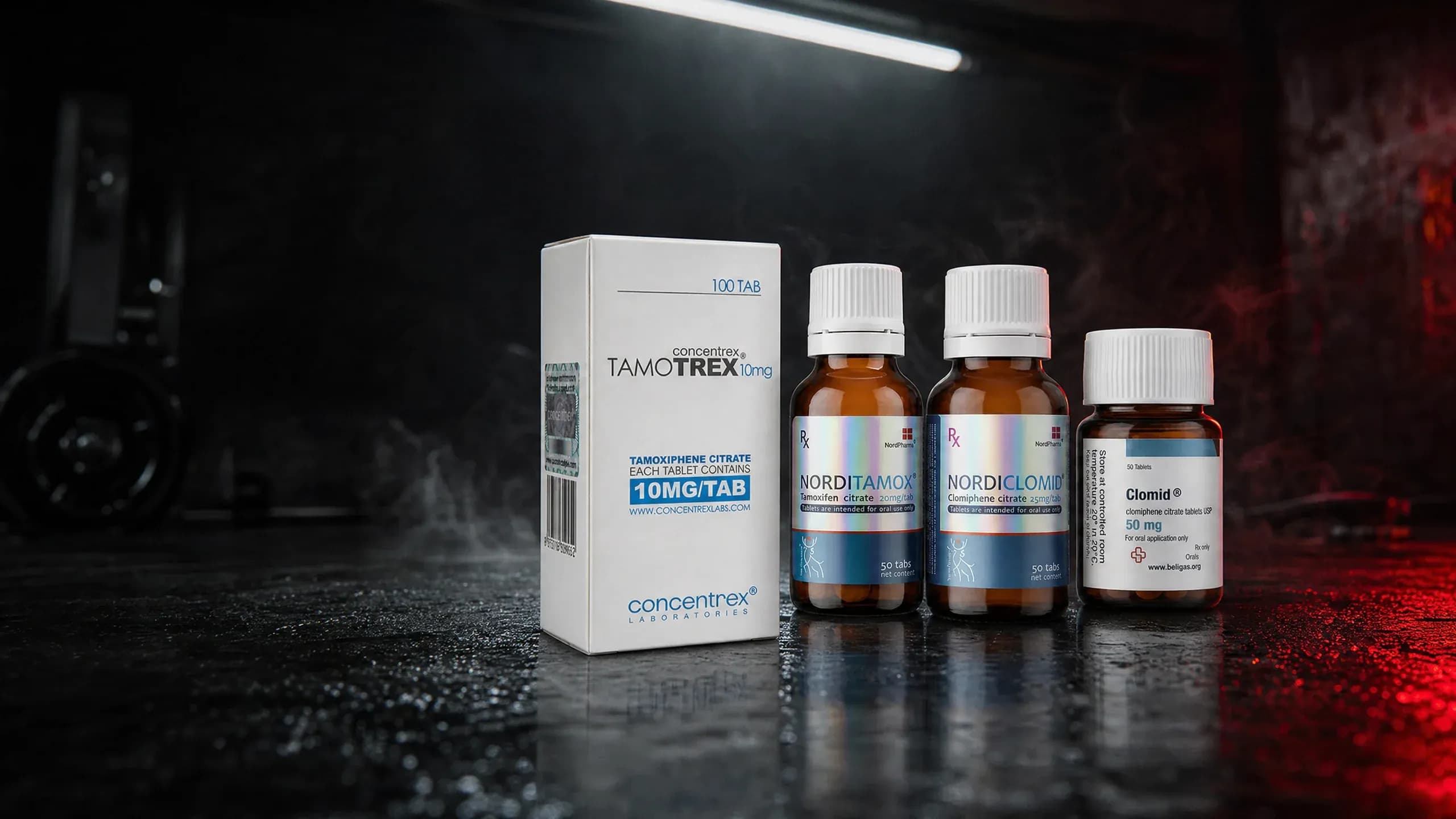
Which one you choose depends on how suppressive the cycle was and how you tolerate the drugs. For a standard moderate cycle, tamoxifen alone is sufficient for most men and is the easier four weeks. Clomiphene alone is the classic alternative — a common practical form is Clomid 50 50mg/tab 50 Tablets by Para Pharma, which at 50 mg per tablet maps directly onto the week-one front-load dose and can be halved for the 25 mg continuation weeks. The combination protocol adds the two mechanisms together and is generally reserved for long, heavy, or multi-compound cycles where a single SERM has previously proven insufficient — accepting the higher side-effect load that comes with it.
Longer is not better. Extending SERMs beyond four to six weeks adds side-effect exposure without evidence of faster or more complete recovery; if bloodwork shows the axis has not restarted after a proper four-week protocol, the answer is a medical workup, not another month of clomiphene. All of the compounds mentioned here, including Clomid 50 50mg/tab 50 Tablets by Para Pharma and the tamoxifen options, are grouped in the PCT section of the shop. And a caution against improvisation: do not invent exotic mega-dose front-loads (100+ mg clomiphene days) copied from forums — higher doses steeply increase the visual and mood side effects with diminishing hormonal return.
Side Effects and Risks of SERMs
SERMs are prescription medicines with real side-effect profiles; "post-cycle" does not mean "harmless."
- Clomiphene: mood swings, irritability, and low mood are common enough that some users describe week one as genuinely unpleasant. Rarer but serious are visual disturbances — blurring, floaters, light sensitivity — which are a stop signal, not something to push through. Headaches and occasional nausea also occur.
- Tamoxifen: generally the better-tolerated of the two. Occasional hot flushes, mild nausea, and headache are the usual complaints. As with all SERMs, there is a theoretical thromboembolic risk, relevant mainly for those with clotting history or risk factors.
- Both: transient acne and oily skin are common during PCT — not from the SERMs but from hormone levels swinging back through intermediate ranges. Libido often fluctuates oddly for a few weeks before stabilising.
The deeper risk of PCT is not the drugs — it is false confidence. Feeling recovered is not the same as being recovered; libido and gym performance can return while total testosterone is still below baseline. Equally, some men do not recover fully, especially after years of back-to-back cycles with insufficient time off. If post-PCT bloodwork shows persistent hypogonadism, that is a conversation for an endocrinologist, not a second self-prescribed PCT round.
Bloodwork: Baseline, and Proof of Recovery
PCT without bloodwork is guesswork with pharmaceuticals. Two draws define the protocol:
- Baseline, before the cycle: total and free testosterone, LH, FSH, oestradiol (plus lipids, liver enzymes, and haematocrit for the cycle itself). Without a baseline, your post-PCT numbers are uninterpretable — you cannot know whether you have recovered if you never knew where you started.
- Post-PCT, 4–6 weeks after the last SERM dose: the same hormone panel. Testing earlier than this misleads in both directions — SERMs artificially elevate LH/FSH while you are taking them, so blood drawn during or immediately after PCT overstates recovery.
What you want to see: total testosterone back within (or near) your baseline range, LH and FSH within reference, and oestradiol in a normal ratio to testosterone. If total testosterone is still low with low-normal LH four to six weeks after PCT, the axis has not restarted properly — that warrants medical evaluation.
FAQ
Can I skip PCT and just wait for natural recovery?
You can, and your body will usually restart on its own — eventually. The cost is months in a hypogonadal state: lost gains, low mood, absent libido, and poor recovery from training. PCT exists to compress that window from potentially three to six months down to roughly four to eight weeks. Skipping it does not avoid suppression; it just extends the period in which you pay for it. For any cycle beyond a trivial dose, skipping PCT is the objectively worse trade.
Should I use Clomid, Nolvadex, or both together?
For a standard moderate cycle, tamoxifen alone at 20–40 mg/day for four weeks is sufficient for most men and is the better-tolerated option. Clomiphene alone at 25–50 mg/day is the classic alternative. The combination is reserved for long, heavy, or multi-compound cycles where recovery is expected to be difficult — accepting the higher side-effect burden, particularly clomiphene's mood effects. More drugs is not automatically better recovery.
What happens if I start PCT too early?
You waste it. SERMs cannot restart the HPTA axis while exogenous hormone levels are still suppressive — the hypothalamus still detects high androgens and keeps GnRH output down regardless of estrogen-receptor blockade. That is why the clearance window matters: roughly 3–5 days after orals and short esters, 14–21 days after long esters like enanthate, cypionate, or decanoate. When in doubt, start a few days late rather than early.
Can I run HCG at the same time as Clomid or Nolvadex?
No — this is one of the most common protocol errors. HCG mimics LH and is itself suppressive at the hypothalamic level, so taking it alongside SERMs works directly against the restart PCT is trying to achieve. If HCG is used at all, it belongs in the final weeks of the cycle or the clearance gap, finishing before the first SERM dose. Many successful PCTs use no HCG at all; it is optional, not required.
How do I know if my PCT actually worked?
Only bloodwork answers that. Test total and free testosterone, LH, FSH, and oestradiol four to six weeks after your last SERM dose and compare against your pre-cycle baseline. Testosterone back in your baseline range with LH and FSH in reference means the axis has restarted. Feeling good is encouraging but unreliable — libido and gym performance often return before hormones fully normalise, and can also fade again if recovery is incomplete.
Do women need PCT after a cycle?
No. PCT exists to restart the male hypothalamic-pituitary-gonadal axis after suppressive androgen use. Women do not have the same axis-to-testes feedback loop and do not experience the relevant HPTA suppression, so SERM-based PCT is not applicable. Female users face a different risk profile — virilisation, voice changes, menstrual disruption — that PCT does not address and that is managed through conservative compound and dose selection instead.
Conclusion
PCT is the part of a cycle that determines what you keep — and it is the part most often improvised, mistimed, or skipped. The honest summary: suppression is guaranteed by any effective cycle; recovery is not. A disciplined PCT — SERMs started after the correct ester-dependent gap, run for about four weeks at standard doses, with HCG kept strictly before the SERM phase if used at all — shortens the hypogonadal window from months to weeks. The SERMs themselves carry real side effects: clomiphene's mood swings and rare visual disturbances, tamoxifen's milder but nonzero burden, and a theoretical clotting risk for both. These are prescription drugs, and treating them as risk-free because they come "after" the cycle is a mistake.
Who should not be running PCT at all: anyone who has not yet run a cycle — if you are reading this pre-emptively, the more important question is whether your training age, baseline bloodwork, and life situation justify the first cycle, because roughly under 25 and without monitoring discipline the answer is no. Anyone with clotting disorders or significant psychiatric history should discuss SERMs with a physician first. And anyone unwilling to do bloodwork — baseline before the cycle and a follow-up panel four to six weeks after PCT — is not running a protocol, just taking pills and hoping. The athletes who keep their health and their gains treat recovery with the same seriousness as the cycle itself: planned in advance, timed to the pharmacology, and verified by numbers rather than by feel.