Masteron (Drostanolone): Propionate vs Enanthate, Cycle, Use Cases
Masteron (drostanolone) delivers a dry, hard look — but only below 10–12% body fat. Learn how propionate and enanthate differ, what a typical 8–12 week cycle looks like, and which side effects and PCT timing to expect.
Masteron (Drostanolone): Propionate vs Enanthate, Cycle, Use Cases
TL;DR
- Masteron (drostanolone) is a DHT-derived injectable that does not aromatise, produces a dry, hard look, and only justifies its place in a cycle when body fat is already low — below roughly 10–12%.
- Propionate (half-life ~2–3 days, injections every other day) suits shorter cutting phases; enanthate (half-life ~7–10 days, two injections per week) suits longer runs and anyone who dislikes frequent pinning.
- Typical doses run 300–500 mg per week; a classic masteron cycle pairs 350–400 mg of drostanolone with 300–500 mg of testosterone over 8–12 weeks.
- Masteron is mild on oestrogen but not mild overall: it suppresses natural testosterone, hits HDL cholesterol, and accelerates hair loss in genetically predisposed users.
- PCT timing depends on the ester — about 3–5 days after the last propionate shot, roughly two weeks after enanthate — and bloodwork before, during, and after is non-negotiable.
What Masteron (Drostanolone) Is
Drostanolone is a dihydrotestosterone derivative — specifically 2α-methyl-DHT — developed in the late 1950s and used clinically for decades as a treatment for advanced breast cancer in women, precisely because it cannot convert to oestrogen and appears to blunt oestrogenic signalling in tissue. That same property is what makes it popular in physique sports: it adds lean tissue and hardness without any water retention, and its androgenic character sharpens the visual effect of low body fat rather than building size.
What Masteron is not is a mass builder. Its anabolic effect is modest, its strength gains are real but unspectacular, and on a calorie surplus it is almost always outclassed by cheaper compounds. Its reputation rests on what it does at the end of a diet: a drier, denser, more "grainy" look, mild anti-oestrogenic support alongside aromatising compounds, and a generally calm side-effect profile at sensible doses. Expectations set anywhere above that lead to disappointment.
Propionate vs Enanthate: Which Ester and When
The active hormone is identical in both versions; the ester only controls release speed and, with it, injection frequency and cycle planning.
Property | Drostanolone propionate | Drostanolone enanthate |
|---|---|---|
Half-life | ~2–3 days | ~7–10 days |
Injection frequency | Every other day (3–4 ×/week) | 2 × per week |
Full clearance after last shot | ~3–5 days | ~2–3 weeks |
Best fit | 8–10 week cuts, contest prep final phase, first Masteron run | 10–14 week cycles, fewer injections, pairing with long-ester testosterone |
PCT start after last injection | Day 3–5 | ~Day 14 |
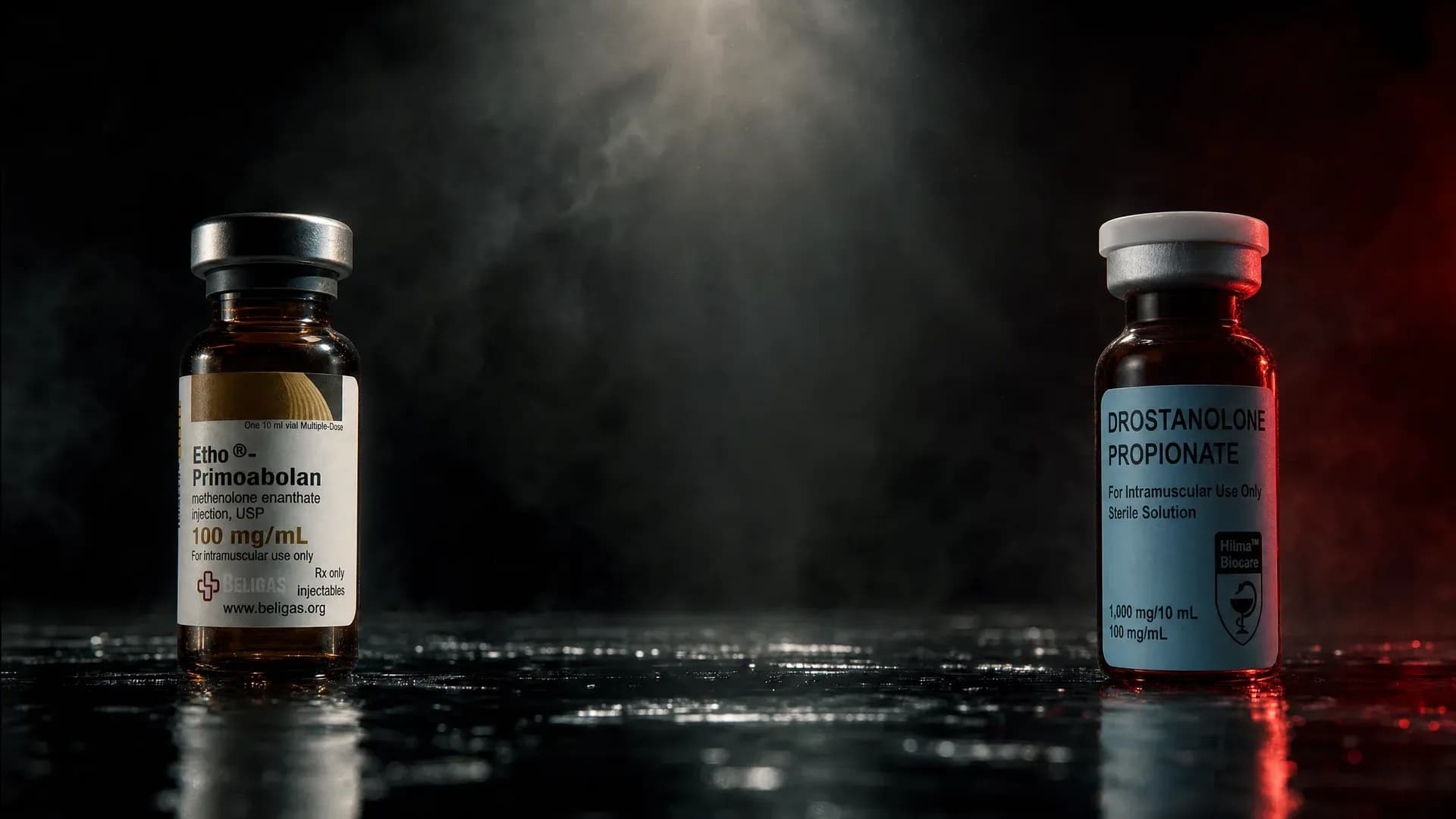
Propionate is the traditional form — historically the only one — and its short ester has one real advantage: if side effects or a change of plan force you to stop, it clears in days. It also pairs naturally with testosterone propionate in short, sharp prep cycles. The cost is injection frequency, and propionate is notorious for post-injection pain in some formulations. Most drostanolone propionate products are dosed at 100 mg/ml, and the full selection sits in the Drostanolone Propionate category.
Enanthate trades that flexibility for convenience. Two injections per week produce stable levels, which suits longer cycles and matches the pinning schedule of testosterone enanthate or cypionate. In practice it is commonly supplied at 100 mg/ml or 200 mg/ml — examples include Drostanolone Enanthate 100mg/ml 10ml Vial by Kim Pharma and Drostanolone Enanthate 100mg/ml 10ml Vial by Swiss Pharma, both at the standard 100 mg/ml concentration, meaning a 400 mg week is two 2 ml injections. The drawback is the slow exit: misjudged timing pushes PCT back, and any adverse reaction lingers for weeks rather than days.
Dosage and Cycle Design
Masteron dosing clusters into fairly stable bands, and going above them buys little.
Experience level | Weekly drostanolone dose | Typical testosterone base | Cycle length |
|---|---|---|---|
First Masteron run | 300–400 mg | 300–500 mg | 8–10 weeks (prop) / 10–12 weeks (enth) |
Intermediate | 400–500 mg | 400–600 mg | 10–12 weeks |
Advanced / prep | 500–600 mg | varies, often tapered into show | 6–8 weeks (final prep phase) |
Two principles govern a sensible masteron cycle. First, Masteron is a companion compound, not a base: run alongside testosterone, it contributes hardness and frees up the look of the cycle; run alone, its anabolic contribution rarely justifies the suppression. Most users pair propionate with testosterone propionate and enanthate with testosterone enanthate — if you need a refresher on structuring the testosterone side of the stack, the Testosterone Enanthate Cycle Guide covers doses, schedules, and clearance timing in detail. Second, dose-response flattens early: the visual difference between 300 and 450 mg per week is noticeable; between 500 and 700 mg it is marginal, while lipid damage and androgenic sides keep climbing.
A standard intermediate layout looks like this:
Week | Drostanolone propionate | Testosterone propionate | Actions |
|---|---|---|---|
0 | — | — | Baseline bloodwork: hormones, lipids, haematocrit, blood pressure |
1–10 | 100 mg EOD (~350 mg/week) | 100 mg EOD (~350 mg/week) | Diet in deficit or maintenance; training unchanged |
5–6 | — | — | Mid-cycle bloodwork: lipids, E2, haematocrit |
11–12 | None | None | Ester clearance |
12–16 | PCT | PCT | SERM protocol, ~4 weeks |
With enanthate esters, extend to 12 weeks and shift PCT two weeks after the final shot.
Use Cases: Cutting, Contest Prep, and Recomp
Masteron earns its keep in three scenarios, and only loosely elsewhere. The first is a dedicated cut where the user is already lean: below roughly 10–12% body fat, drostanolone's dryness and mild anti-oestrogen effect become visibly obvious — harder delts, sharper separation, less subcutaneous water. Above that body-fat range, the effect is largely cosmetic placebo; the compound cannot reveal definition that fat is covering.
The second is contest prep, where it has been a staple for decades, typically introduced in the final 6–8 weeks at 400–600 mg per week alongside a tapered testosterone dose. The third is a lean recomposition, where its moderate anabolism and zero water retention keep the scale honest and the look clean. In that context it is frequently compared to Primobolan — the other "mild DHT-family" cutting compound — and the trade-offs between them (cost, faking risk, androgenicity, and effect at equal dose) are examined in Primobolan Vs Masteron DHT Derivatives For Recomp And Cutting. What Masteron is not suited for is an off-season bulk or a first-ever cycle: its contribution is too subtle to justify the suppression cost when simpler options exist.
Side Effects and Risks
Masteron's reputation for being "mild" is accurate only relative to harsher compounds — and only within its non-estrogenic lane.
- Suppression: guaranteed, like every anabolic steroid. Natural testosterone production shuts down within weeks, which is why a testosterone base and PCT are standard practice.
- Lipids: DHT derivatives suppress HDL cholesterol meaningfully. Expect a measurable HDL drop at 400+ mg/week; in a calorie deficit with cardio this is partly offset, but it must be tracked, not assumed away.
- Androgenic effects: as a DHT derivative, Masteron accelerates male-pattern baldness in predisposed users and can aggravate acne and prostate symptoms. If hair loss runs in your family, treat this as a near-certainty rather than a possibility.
- No oestrogenic side effects: no aromatisation means no gyno risk and no water retention from Masteron itself — but oestrogen from the accompanying testosterone still needs management.
- Not hepatotoxic: as an injectable non-17α-alkylated compound, it carries no direct liver toxicity, though stacking it with orals changes that picture.
Bloodwork and PCT
The monitoring protocol mirrors any injectable cycle: a baseline panel before the first injection, a mid-cycle draw around week 5–6, and post-PCT confirmation. Prioritise the lipid panel (HDL/LDL/triglycerides), total and free testosterone, oestradiol by sensitive assay (driven by the testosterone base, not the Masteron), haematocrit, and blood pressure. A PSA check is prudent for users over 35 given the DHT load.
PCT timing is the ester question in reverse. After propionate, start a SERM protocol on day 3–5; after enanthate, wait roughly 14 days. A standard four-week course — tamoxifen at 20 mg/day or enclomiphene at 12.5–25 mg/day — restarts the axis in most users, and follow-up bloodwork three to four weeks after PCT ends is the only way to know it worked. Recovery is verified with numbers, never with vibes.
FAQ
Is Masteron worth using if I'm not already lean?
Honestly, no — and this is the most common misuse. Drostanolone's signature effects are cosmetic and surface-level: dryness, hardness, visible density. At 15% body fat or above, subcutaneous fat hides everything the compound does, leaving you with the suppression and lipid costs and almost none of the payoff. Get lean first with diet and a simpler cycle; Masteron is a finishing tool for the last stretch, not a shortcut to it.
Which ester should I choose for my first Masteron cycle?
Propionate, in most cases. The short ester clears within days if you react badly, the every-other-day schedule teaches you injection discipline, and 8–10 weeks is a sensible first exposure. The trade-off is frequent injections and occasional post-injection pain. Choose enanthate only if you are already running a long-ester testosterone cycle and want matching schedules, and accept that any problem takes two to three weeks to leave your system.
Can Masteron replace an aromatase inhibitor on cycle?
No. Drostanolone has mild anti-oestrogenic properties in tissue, which is why it was used against breast cancer, but it does not inhibit aromatase and does not reliably control systemic oestradiol from a testosterone base. Some users find it softens high-E2 symptoms; bloodwork still occasionally shows elevated oestradiol underneath. Manage E2 with proper testing and, if needed, a real AI at the lowest effective dose — Masteron is not a substitute.
Will Masteron make me lose my hair?
If you carry the genetics for male-pattern baldness, assume yes — Masteron is a DHT derivative, and DHT is precisely the hormone that miniaturises susceptible follicles. It cannot be blocked with finasteride either, since drostanolone is already in its "reduced" androgenic form and does not depend on 5α-reductase. If your hairline is stable and baldness is absent from your family, the risk is lower but not zero.
How fast does Masteron kick in?
With propionate, most users notice the cosmetic shift — drier look, harder muscles, slightly improved vascularity — within two to three weeks, assuming body fat is low enough to see it. Enanthate takes longer to saturate, with visible effects more like weeks four to six. If you are ten weeks into a lean cut and see nothing at all, suspect underdosed or substituted product; Masteron is frequently faked or replaced with cheaper compounds on the grey market.
Do I need PCT after a Masteron-only cycle?
Yes. Even without a testosterone base, drostanolone suppresses the hypothalamic-pituitary-gonadal axis like any other anabolic steroid. Skipping PCT because the compound felt "mild" is a common and costly mistake that risks months of low-testosterone symptoms: lost gains, poor mood, flat libido. Start a SERM roughly 3–5 days after the last propionate injection or about two weeks after enanthate, and confirm recovery with post-PCT bloodwork.
Conclusion
Masteron is a specialist's compound with a narrow, honest job description: polish a physique that is already lean, add dryness without water, and do it with a calmer side-effect profile than most alternatives. It does not build meaningful mass, it does not forgive high body fat, and its "mild" label hides real costs — guaranteed suppression, measurable HDL damage, and permanent hair loss for the genetically unlucky. Anyone under roughly 25, anyone with pre-existing lipid, prostate, or blood-pressure problems, and anyone unwilling to run baseline, mid-cycle, and post-PCT bloodwork should not touch it; the compound will still exist after those issues are resolved. For the user who does qualify: 300–500 mg per week alongside a testosterone base, eight to twelve weeks matched to the ester, PCT timed to clearance, and every decision steered by blood tests rather than forum lore. Used that way, Masteron delivers exactly what it promises — nothing more, and that is precisely the point.